Category Archives: Business Value

Jet.com’s Pivot

Jet.com started out with a simple promise.  Lowest price for any product it sells.  It had a membership model ($50 annual membership fee) as the primary source of (net) revenues (akin to Costco and Sam’s club), and a simple goal of not losing money with each transaction.  Further it promised that more you buy, the more you save with its “smart cart pricing engine”.

Fast forward 10 weeks from launch, Jet.com pivots, and decides to do away with its membership model. Why?  There are few hypotheses:

  • Not the lowest prices after all:   Jet.com, in our analysis of competitive prices, was lower than Amazon prices by 3%-4% on average, but for 70%-80% of the products analyzed across select categories, Jet.com just matched Amazon prices, and not lower as per the marketing hype.   There is negligible price advantage buying at Jet.com for most transactions to compensate for the membership fees.  Other retailers also made aggressive moves by offering price match guarantees (Sears, Staples, Best Buy, Target, Walmart to name a few) have destroyed Jet’s lowest price positioning and Amazon responded by lowering its prices even further.
  • Limited breadth (across categories) and depth (selection, brands in each category): This needs no explanation.
  • Member acquisition hurdle: With limited selection and no price advantage, Amazon Prime (and Costco and Sam’s club) members have little reason to give up existing memberships or add Jet.com subscription.
  • Unsatisfactory UX:  Granted Jet.com is an upstart building a business, without reviews and recommendations which require shopper data, but could do better at designing for a better UX and not just the UI.

Now how will Jet.com make money?  It only has one secret sauce to highlight: “smart cart” pricing engine.   Otherwise, Jet.com is just another online retailer competing for your wallet.   Or will this pivot open the floodgates? Or will Jet.com position as a technology company by empowering brands, sellers, and shoppers with a marketplace better than Amazon and eBay (a non-trivial endeavor for a late entrant).
White-box or Black-box Marketing Analytics?

Many professional services firms claim to have proprietary (or black-box) frameworks and approaches to develop and execute business strategies.    Ability to anticipate the future, creativity, focus, discipline, and analytical horsepower are necessary conditions for business success.  A missing ingredient, for converting business strategies into executable plans and actions, requires organizations to be transparent, encourage healthy debates and challenge assumptions and internal biases, with a clear understanding of data-driven insights and associated limitations.

We are proponents of white-box analytics for the following reasons:

  1. Stories are more compelling than data:  To design new products and services, transform organizations, and build innovative business models, insights from data need to be synthesized into bite (or byte)-sized portions and woven into compelling stories to induce organizational and operational DNA mutations.
  2. Capability development for repeatable and reliable analytics:  The scientific principles underlying a white-box approach, permit internal teams to evaluate the analytical techniques in new contexts and with new data. This ensures development of repeatable systems and decision processes.  Even if you outsource select analytics initiatives, you have to develop internal capability to make core analytics a competitive differentiator and engine of continuous business success.
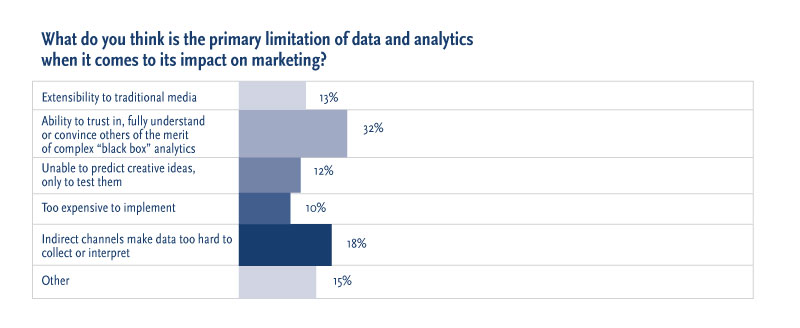
  3. Credibility and trustworthiness of data and approach:  Many CMOs don’t trust big data, analytics, and tools (see below).  Consequently, new ways of doing things are rarely internalized.  Enterprises must internalize and trust the data, analytics, and the underlying assumptions and context in which the insights are generated.  A white-box approach increases the odds of engendering trust, and insights and findings to permeate the organization – teams spread a key insight only if it is trustworthy.
  4. Continuous refinements to analytical techniques:  Often analytical approaches need to evolve as available data, types of data, consumer behaviors, and markets change.   Since these refinements need to be executed within the client’s organization, white-box approaches permit easier refinements – you can’t refine what you don’t understand.
  5. Better creative solutions:  White-box approaches typically favor a deeper understanding of “causes and effects” (“why” questions are more important than the “what” questions for strategic decisions) leading to more creative solutions to marketing strategy development and execution.

Source:  Big Data and the CMO: What’s Changing for Marketing Leadership? CMO Summit Survey Results, Spencer Stuart, April 2013.


From worst to best: What can businesses learn from the Boston Red Sox?

There are often lessons for business from popular culture, arts, and sports.  Here are some lessons from the 2013 Boston Red Sox World Series win.

  1. From tragedy to triumph:  On April 15, 2013, bombings near the finish line of the Boston Marathon killed three people and injured at least 250.  As Rahm Emanuel, Chicago Mayor and ex-White House Chief of Staff said: “You never let a serious crisis go to waste.”   Use your crises as learning moments and catalysts for change.  Also, pay careful attention post-crisis, since crises often lead to poor decisions under business stress.
  2. New leaders challenge the status quo:  With almost similar talent, a new leader, such as a calm, composed, and cerebral manager John Farrell, can make a huge difference.
  3. Visible symbols matter:  Almost all Boston Red Sox players sported ugly, scraggly, preposterous, and sometimes well-groomed beards.  But the beards unified the team in more ways than one.  Also note that the unifying beards didn’t happen at the start of the season.  Rather, they became more prominent midseason as more team members aligned on a shared purpose.
  4. Opportunity to rebuild your team:  Red Sox GM Ben Cherington signed the right players last offseason.  He didn’t have to bring aboard the biggest stars, but got his picks to contribute to winning.  A deftly crafted team with a diversity of skills, experiences, and perspectives will fight hard to succeed.
  5. Culture can change faster than you think:  Often organizational and operational DNA is a key driver of business success.  But there is the myth that cultural change is evolutionary and not revolutionary.  Select changes in a team – such as removal of bad apples swiftly – and bringing in fresh thinking can change the company’s culture faster than most expect, especially after going through a health crisis.
  6. Purpose beats singular focus on business:  It is not just about winning – after all who wants to lose.  But having a higher purpose – to help heal a city – mobilizes all your talent and resources to work together.  In a similar vein, businesses should give priority to a shared purpose – even ahead of business performance metrics such as revenues and margins.  Then, winning is just a by-product.
  7. Reallocate resources for transformational change:  It is easier to reallocate and optimize resources when you are at the bottom than when you are at the top.  Hitherto hard decisions become easy ones as there is less opposition to change and a new sense of urgency drives transformational change in organizations.

Big Data Quote of the Day: 11/01/2013

Quotes in Big Data’ Is Bunk, Obama Campaign’s Tech Guru Tells University Leaders:

“The ‘big’ there is purely marketing,” Mr. Reed said. “This is all fear … This is about you buying big expensive servers and whatnot.”

“The exciting thing is you can get a lot of this stuff done just in Excel,” he said. “You don’t need these big platforms. You don’t need all this big fancy stuff. If anyone says ‘big’ in front of it, you should look at them very skeptically … You can tell charlatans when they say ‘big’ in front of everything.”

**************

Yes, it is true that some data analysis can be done in Excel – for Small Data.   But you may need to process Big Data and synthesize , i.e., make it Small Data, before you can work with Excel.    The value arises from the art and science of data synthesis.

It doesn’t matter what tool you use to process the data.  The most important driver of business performance is whether you have an evidence-based or data-driven decision-making culture in your organization and operations.  If you haven’t used Small Data (survey data, transactional data, etc,.) for developing and executing strategies, and improving business performance in the past, you will be wasting money with your Big Data initiatives.

Business Value of Big Data Analytics

A recent Bain study suggests that  that early adopters of Big Data analytics have gained a significant lead over their competitors.  Bain studied 400+ large companies and found that those with most advanced analytics capabilities are outperforming competitors in more ways then one:  improved financial performance, faster decision-making, more effective execution, and adaptive  decisioning.

          *****************

It is often difficult to disentangle cause and effects –  companies achieved top performance in part due to advanced analytics or top performers are more likely to have an evidence-based organizational and operational DNA and leveraging analytics is just a manifestation of the underlying DNA.   But the positive correlations highlight the significant value potential of Big Data analytics stemming from improved speed and quality of decisions, and continuous refinements during execution.

Custom Technology Solution or Off-the-shelf Software Tool: Revisit Your Decisions

Over the years, given the perceived relative strengths of off-the-shelf software – faster, cheaper, better – compared to custom software, off-the-shelf software (enterprise or hosted) gained popularity.  But the advent of open-source platforms, infrastructure, and tools, has bent the cost curve for custom software, requiring organizations to rethink the custom versus off-the-shelf software decision.

  • Features that matter:  With off-the-shelf software – enterprise or software-as-a-service – you are stuck with the features the software maker provides, not the features that your unique business needs. Off-the-shelf software is either designed for a wide range of businesses across industries, or it is targeted to a particular industry.  In either case, you will need to adapt your decision systems and processes to the tool.
  • Competitive differentiation:  If you’re using off-the-shelf software, it is quite likely so are your competitors. Why would you choose to play on the same level playing field when you can develop advantages that are unique to your business, purpose, and organizational and operational strengths? Custom solution incorporates your proprietary insights and business processes, improving effectiveness and competitive advantage.  Every successful company has to be unique in the marketplace in or of more of the following: internal systems, processes, and decisions, external products, service, and operations.  In particular, for smarter marketing with data, associated uniqueness should be embedded into the data, analysis, or application of insights.  Consequently, there always will be considerable opportunity in custom software.
  • Continuous support and refinement:  Off-the-shelf software typically has basic level of support available with a support staff typically unable to understand the inherent intricacies of your business. With custom software you get in-depth support from an internal or an outsourced team who designed and developed the system.  As businesses and markets evolve, your needs change.  Custom software can adapt faster and more efficiently to your changing needs.   You may be stuck with what you have in off-the-shelf software. 
  • Higher ROI:  In our experience, you incur higher initial costs for design and development (though the cost premium is vanishing with the incorporation of open-source platforms and tools), and lower recurring costs for custom marketing analytics software, compared to off-the-shelf software.  But custom software can also deliver persistent incremental revenue premium.  Consequently, well-designed and implemented custom software solutions can deliver a greater return on investment.
  • Business application:  For basic plumbing and infrastructure go for the standard off-the-shelf and open source platforms and tools.  For simple analytics applications such as metrics and reporting, continue to adopt off-the-shelf apps.  But for predictive analytics, cause-effect analytics, and real-time marketing decision engines, you need custom software since this is the sweet spot for competitive differentiation: either in data or how data are consumed (I’ll expand on this topic in a future post).
  • Time to value:  Custom software, even with a scotch-tape approach built on top of open source platforms to (dis)prove a new way of thinking and doing, is often preferable to off-the-shelf software in terms of time to realize measurable business value.   It may not take a long time and internal resources to develop custom software, compared to even a decade back.  Rapid prototyping approaches have resulted in the development of great custom software quickly.
  • Maintenance:  With custom software hosted on the cloud, there are minimal ongoing costs associated with IT personnel.   Of course, there is need for data exchange – periodically in batch mode or continuously in real-time – between the business and the hosted solution provider.   But once the initial data integration hurdle is crossed, the rest is mostly business value generation.
  • Code ownership:  In a custom technology solution, the client owns the source code, except the modules embedding any proprietary algorithms of the system developer.

****************

We realize that the custom or off-the-shelf software decision is not an easy one.  But with the advent of open-source platforms and technologies, challenge the status quo, and revisit this important decision.


From Big Data to Business Value: No Silver Bullet

Self-proclaimed Big Data experts and management gurus, claim that you get to insight nirvana, often in few easy steps.    Just to cite some examples:

  1. Four Steps To Turn Big Data Into Action
  2. The seven steps of big data delivery | SAS
  3. Three Simple Steps to Big Data Intelligence – Crimson Hexagon
  4. Six Steps to Extract Value from Big Data – Datanami
  5. Steps to Start Your Big Data Journey
  6. Four Steps to Success with Big Data
  7. Steps for Tackling Big Data
  8. Steps to Better Big Data Insight
  9. Steps to Maximize the Potential of a Big Data Strategy
  10. Five first steps to creating an effective ‘big data‘ analytics program

And the list goes on…

*********************

Such proclamations lead to unmet expectations from analytics initiatives.  Going beyond insight and delivering measurable business impact requires discipline, focused effort, a sprinkling of luck, resiliency, a bout of creativity, and a dash of imagination.   After having lived more than two decades with data (often with large transactional databases and even raw web log data –  i.e., big data before it became a buzz word) of various shapes and sizes and their use in marketing and advertising decisions, my takeaways:

  • Analytics as a process is never linear since data analysis and insight generation is a never ending journey with many twists and u-turns.
  • Outcomes of the analysis can be unknown and even uncertain at the outset
  • Discipline and structured thinking are as important as embracing out-of-the-box thoughts and imaginations
  • Fortune favors the brave:    Luck plays a role while looking for the proverbial needle in the haystack.
  • Focus on the business goals and key questions since data and analytics will follow naturally.
  • Challenge the status quo:  Plan for required changes to”how things are done within the organization” based on what you may learn.
  • Anticipate internal and external opposition to change:  The biggest obstacle to realizing value from big data will come from organizational inertia.
  • Think system, processes and decision rights before data and analyses.
  • Patience is a virtue:   As Billie Jean King said: “Champions keep playing until they get it right.”

Big Data Generates Business Value – Outside Usual Suspects

There are very few demonstrated successes of big data at organizations excluding Amazon, Facebook, Netflix, Google, Twitter, etc,.   A recent article Big Data Success: 3 Companies Share Secrets in Information Week, highlights three companies (MetLife, British Airways, and Tivo Research Analytics) developing and implementing big data initiatives.   Some common themes:

  1. Size of data doesn’t matter.  Integrating data from different sources and “connecting the dots” can generate substantial business value.
  2. Time to value can be short.
  3. Business goal-driven big data project instead of data-driven big data project
  4. Business sense is as important as data sense.
  5. Perfection is the enemy of the good
  6. Simple analytics with creative data enrichment/fusion may beat advanced analytics on limited data.

It is heartening to read about such successes and business value generation instead of getting bogged down by how to define Big Data.