Category Archives: Predictive Analytics

What is missing in ad tech?

Programmatic buying and precision targeting/marketing ecosystems are enjoying phenomenal growth, and is expected to capture 80% of the online display/mobile/video ad market by 2018.  It is just a matter of time (1-2 years) before the same buying principles/mechanism will capture bulk of TV, radio,  digital billboard, and other buys.   The digital ad technology stack is complex with stringent latency requirements for making a myriad of decisions within 10s of milliseconds.  But ad tech fails miserably in a very simple, but frequently occurring, use case:

  1. A shopper goes to an online retailer and considers some products, conducts some searches, etc.
  2. Shopper is interrupted by a tweet, a text, email about a breaking news story ( or a crying baby)
  3. Shopper goes to cnn.com to learn more.
  4. Every ad on cnn.com is from the online retailer (see below from a recent personal experience).

fullpage

Naturally many questions arise in this mundane setting:

  • Conversion credit: Should the retargeting vendor (Criteo in this case) be credited with a conversion if a sale occurs?  Remember, my “other” tab still points to the retailer and I am actively shopping.
  • Overpayment: If it was an impression-based buy, then did the retailer pay Criteo unnecessarily? Maybe for 1 or 2 impression, but not for all 5.
  • Ecosystem complexity:  Criteo, after flexing its math muscle, determined that serving me a retargeted ad is economically advantageous (aka ROI) for the retailer and bid for the spot.  Criteo chanced to bid and win independently for each of the 5 spots on the same page.  Should Criteo be blamed for the situation? Note how each of the 5 spots hopped through multiple exchanges and networks as hot potatoes in milliseconds, while cnn.com is still serving up the page, all in parallel with 10s, 100s or 1000s of bidders bidding for each spot in real-time.  More importantly, Criteo can’t be sure whether it would win any, some, or all of the spots, or reliably know the ad page domain or URL (due to deliberate and accidental obfuscations inherent in the ecosystem).
  • Intent:  Every one thinks (or claims) that recency of behavioral markers plays a critical role in driving ad performance, but should the time dimension for intent be measured in seconds, minutes, hours or days?  It depends on many factors such as the product category, complexity of the consumer decision.  intent’s TTL/expiration, etc.


So what is missing in ad tech – common sense.  Ad ecosystem players are having heated and fruitless debates on viewability, transparency, and standardization of associated metrics (should online display viewability be measured as half the ad’s pixels potentially “viewable” for 1 second, half a video ad played, etc., which are similar to TV’s “opportunity to see” notions),  but I venture that the discussion should instead focus on:

  • Ad fraud (no one gains except the fraudsters)
  • Long-term and short-term impacts: Incremental brand  (will the buy influence and change the target’s perceptions of the brand) and ROI (will the target change behaviors) metrics vis-a-vis a “no buy.”

jet_front_page

Can Jet.com keep its promise of offering the lowest price for any product?

Jet.com officially launched yesterday.  The retailer can potentially shake up commerce as we know it.   Historically, retailers have focused on select control points for strategic differentiation.

  1. Location:  You have often heard of the “location, location, location” mantra in (offline) retailing.
  2. Selection:  Assortment, breadth of brands, categories, products, prices, focus on quality, etc.
  3. Customer service:  Imagine the experience of buying a bike at a local bike retailer versus buying one at one of the big stores.
  4. Price: EDLP, promotion-driving pricing, value-based pricing, etc.

With the growth of digital and advent of Amazon, additional dimensions of strategic competition and new competencies emerged:

  1. Data:  What does the retailer know about the shopper? Competition? Changing consumer mega and micro trends? Inventory levels?
  2. Algorithms and technology:  How does the retailer leverage aforementioned data to power applications on the demand side (personalized experiences, prices, promotions, offers, tracking, etc.) and the supply side (supply chain, operational efficiencies, drop shipments, etc.)?

Despite the hectic double-digit growth in e-commerce revenues worldwide, with the exception of select pricing innovations such as Priceline.com, e-commerce has remained largely unchanged in the last 20 years.   Jet.com could potentially change the status quo.  Jet.com has borrowed an old and simple idea from the membership model espoused by predominantly offline retailers such as Sam’s Club and Costco, where subscriptions drive retailer margins.  Add in a sprinkling of data, a dash of algorithms, and a shot of technology and Jet.com can revolutionize the consumer experience and become a formidable competitor.  The key strategic shift – imagine a retailer focused on finding  the best price for whatever the member would like to buy, i.e., “Jet.com works for our members.”   Jet.com, supposedly, will do the hard work of continuously monitoring prices, thus eliminating the search costs for consumers, and, for this benefit, the consumer is willing to pay an annual membership fee.  The CEO of Jet.com went a step further claiming that ad revenues (on Jet.com) from retail partners will be returned to Jet’s members by offering consumers even lower prices.

Then the key question is whether Jet.com can continuously monitor prices for any product and ensure that the price paid by its member is lower than any competitor at the time of purchase.  Anecdotal evidence suggests that this is a herculean task, and matters will only get worse as dynamic, personalized pricing (either determined by the retailer through algorithms or pay-what-you-wish pricing wherein the price paid is determined by the shopper) will be more commonplace (more on price differentiation in a later post).

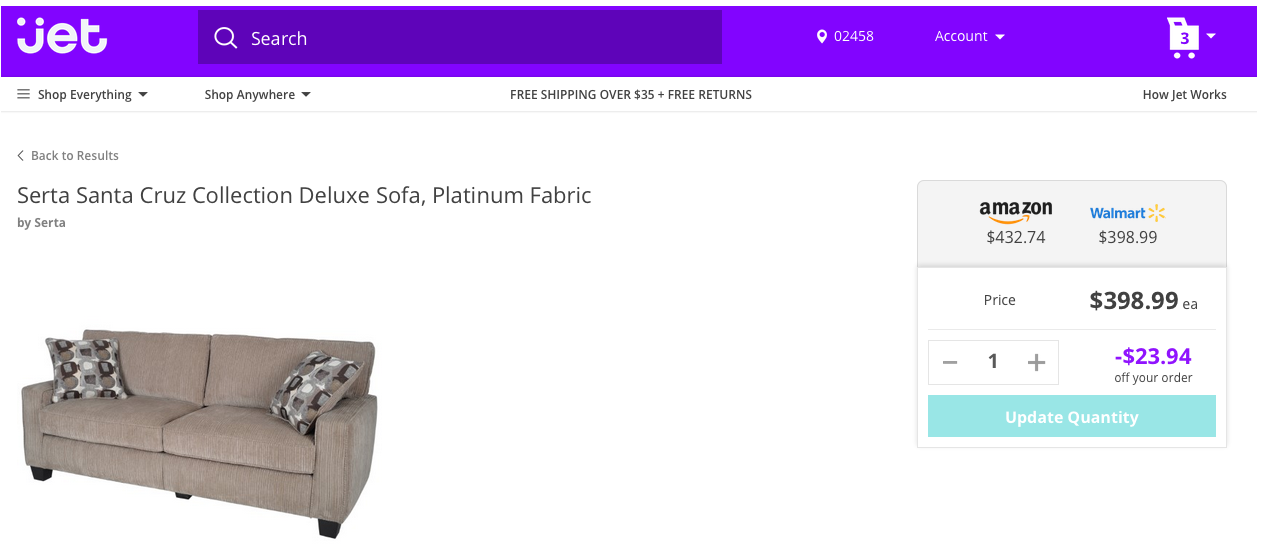
I was looking to buy a sofa and decided to start with Jet.com.  Here is the snapshot of the product page on Jet.com.   It surfaced the Amazon price at $432.74 and Walmart.com price at $398.99, claiming an additional savings of approximately $24.   I moved on to check the prices at Walmart.com and Amazon.com  concurrently.

Product Page on Jet.com


On Amazon.com, a search lead to the exact product priced at $325, which is more than $100 below the Amazon’s price surfaced on Jet.com.   Strike 1.

Product Page on Amazon


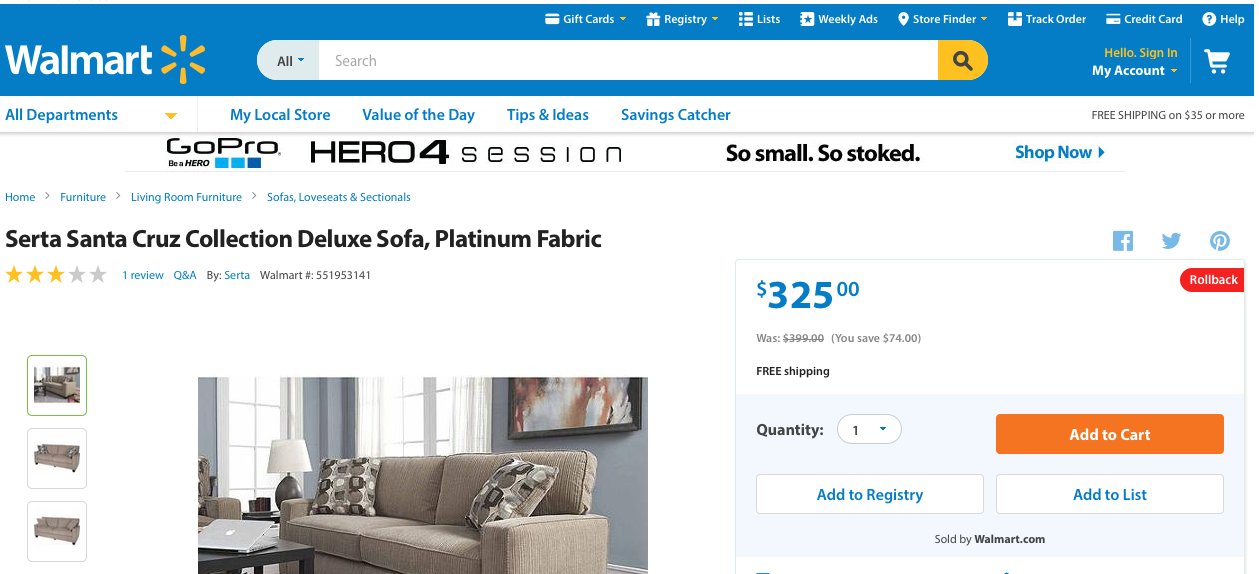
On Walmart.com, the sofa was priced at $325, which is $75 below Walmart’s price surfaced on Jet.com.   Strike 2.

Product Page on Walmart


I am sure Jet.com tried its best to be on top of the prices at Amazon, Walmart and other retailers in its competitive set.  Probably the “crawl” of Amazon and Walmart sites was lagging behind by few hours or even a day, and Jet.com is presenting the latest prices as per its database.   But in a world of “dynamic” prices, when prices change every 10 minutes at sites such as Amazon, and the prices change could be dramatic (as seen in this anecdotal search), how can Jet.com promise to sell at or below lowest price of any other retailer (or  the fixed set of retailers it chooses to price monitor).  The truth will come out in coming weeks and months.

PS:  Note that I was searching for the sofa on the day of the “Black Friday in July” sale at Amazon (which Walmart copied with its own version of “Rollbacks”), and prices were oscillating at higher amplitude and frequency on that particular day and Jet.com’s system were lagging behind in its competitive price awareness more than on a typical day.  When the price discrepancy was raised with the support team at Jet.com, they responded immediately, and blamed it on Amazon’s sale and Walmart’s price matching efforts (note that Jet.com didn’t offer to sell me the sofa at $325).  Interestingly, Best Buy announced today that it will have a Black Friday sale starting Friday July 24, and even going a step further by offering a Cyber Monday.


Predictive Analytics: Hype versus Reality

A quote in a recent PR release from Dresner Advisory Services, an industry analyst covering advanced and predictive analytics:

One clear conclusion we can draw is that there is a substantial gap in adoption of advanced and predictive analytics (A&PA) between the industry-messaging machine of vendors, media, and analysts, and the actual people who generate analytical output in organizations. While awareness of the importance of A&PA is high, adoption and practice are far from universal.

 *************************

Predictive analytics and associated techniques have been around for many decades (we used refer to such techniques as regression analysis – which, by the way, was developed in early 1800s, econometric modeling, or machine learning back then).   In the midst of all the euphoria about the business value of predictive analytics, it is our experience that marketers continue to struggle to operationalize the predictive models into day-to-day decisions.  We had one client whose internal decision sciences team built a complex but unusable model after a multi-month effort, but the model was never operationalized.   We developed a simpler but implementable model and integrated it into a decision-making software tool to guide and automate marketer’s decisions.


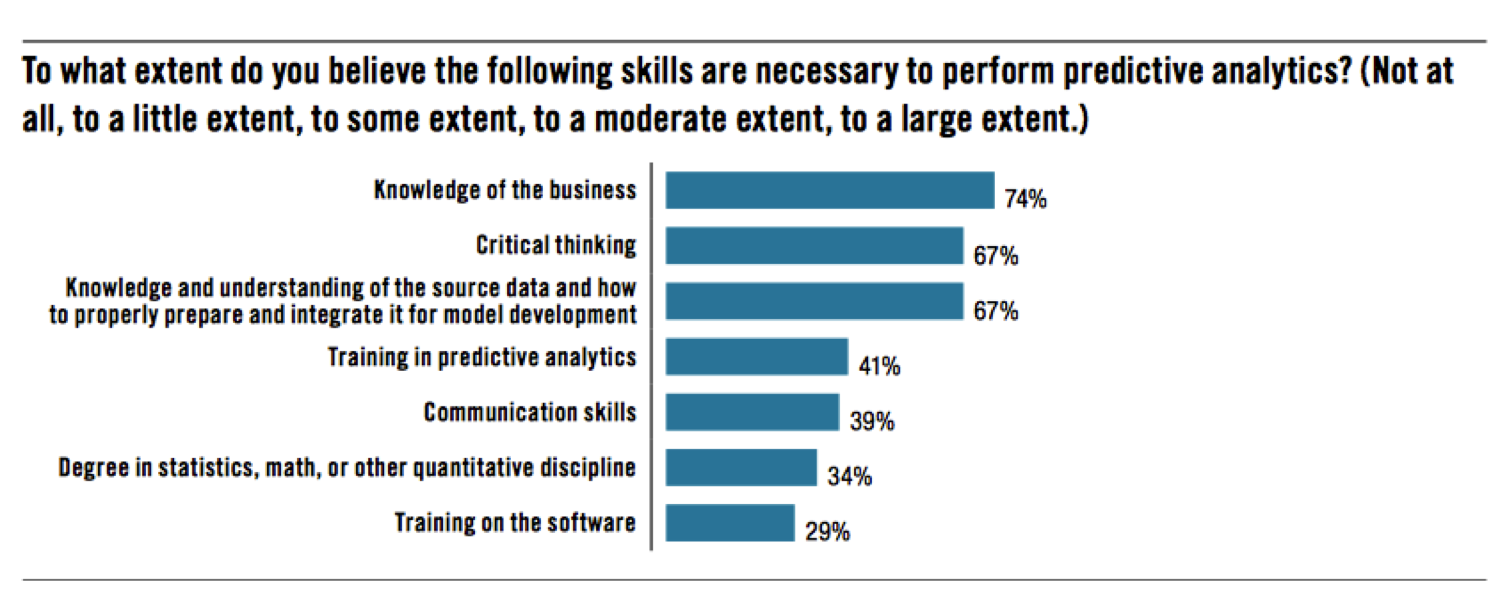
Chart of the Day: 07/19/2014

PredictiveAnalyticsSource: Predictive Analytics for Business Advantage, TDWI Research Report,  2014.

**************************

Having been involved in applying data and analytics to improve speed and quality of business decisions over the last 20+ years, I’ve observed that the best data scientist asks the “so what” question often and obsesses with operationalizing and automating business decisions  stemming from analytics using software, prior to even touching the data.  This often requires envisioning a new future  – modulated by organizational culture, people, and processes – and requisite changes needed for business success.