Category Archives: Marketing mix

Marketing Effectiveness and ROI: The Opportunity

In the age of marketing accountability, one expects more CMOs to have quantitative and nuanced perspectives on what works, when, for which market segments, how, and why?   But the reality, as evidenced in a CMO survey, highlights a paradox and the opportunity for those who get the marketing effectiveness question right.  Only 1 in 3 marketers have a quantitative understanding of the impact of marketing spend, i.e., sales response function.
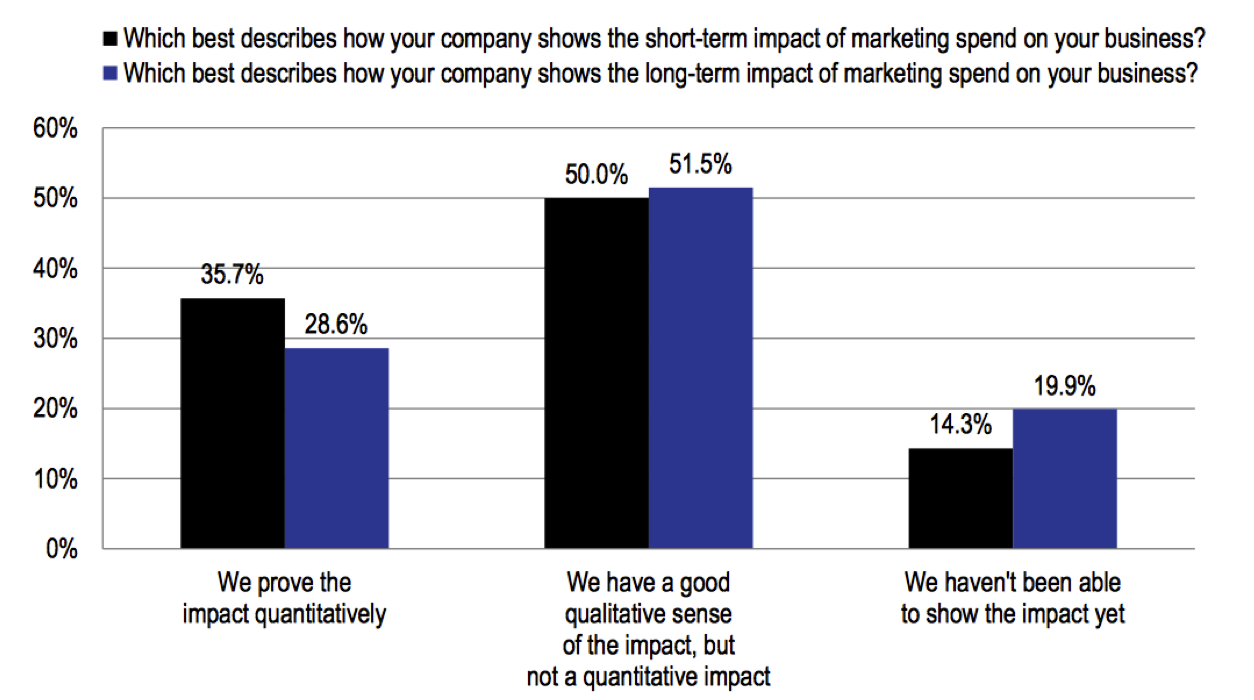
MarketingEffectiveness


Source: CMO Survey February 2014.

The Paradox:   When the same marketers are posed a question on Marketing ROI and how it has changed, CMOs appear confident in responding with a quantitative metric.    If you don’t have a sales response function, how can you venture an ROI?

***********************

Herein, lies the big opportunity for a select group of CMOs to stand out of the crowd, and befriend the CFO (one who obsesses with the real numbers that matter to any business), CTO (one who helps with ensuring that the technology platform and data exist), and CAO (one who can help make sense of the data in the business context and provide visibility into the future, even if it is blurry).
Marketing Effectiveness: Long-term versus short-term effect

In recent years, there has been a growing sentiment (supported by anecdotal evidence) that the long-term effects of advertising is diminishing.    Hypothesized causes include:

  1. Growing impact of digital and information availability in consumer shopping and search processes.
  2. Decreasing (product) brand loyalty.
  3. Consumer culture of “here and now” and fleeting consumer interests across product and shopping categories.
  4. Growing plethora of consumer choices in almost any product category.

A recent study conducted by Nielsen Catalina, Kellogg, and CBS concludes that the long-term effect – defined as total sales lift – range from 1.8 to 4.5 times the short-term sales lift.  Such estimates of long-term effects are even higher than similar assessments almost three decades back, further questioning anecdotal evidence.   The wide variation in long-term effects across brands and categories, further highlights the importance of precisely estimating and incorporating the effects in marketing investment optimization.

In order to tease out the long-term effects of advertising investments, we need more granular data on marketing investments within each media and marketing channel, and sales.

  1. Higher temporal resolution:  Hourly and daily marketing stimuli and investment data instead of typical weekly and monthly data.
  2. Improved spatial resolution:   Investments tracked across markets  – DMAs, states, etc.
  3. More precise targeting resolution:  Who is exposed to the advertising? visitors versus prospects versus customers?
  4. Disaggregate customer and sales data:  Sales from existing customers versus new customers? Conversions rates – prospect to new customer to repeat customer? Frequency of purchases by customer type?  Order value by customer type? Customer-level sales data?
  5. Test and control:   Often,  there is the need to design and execute structured experiments to generate the granular data for estimating long-term effects.
  6. Go beyond sales and profit:  To evaluate lasting effects of advertising, we need to marry brand tracking data with marketing effectiveness analysis.

Collating data spanning the upper and lower paths of the customer decision journey and statistically analyzing the interrelationships provides a stronger foundation for marketing investment decisions.


Business Impact of Marketing Spending: Don’t Be In the Dark

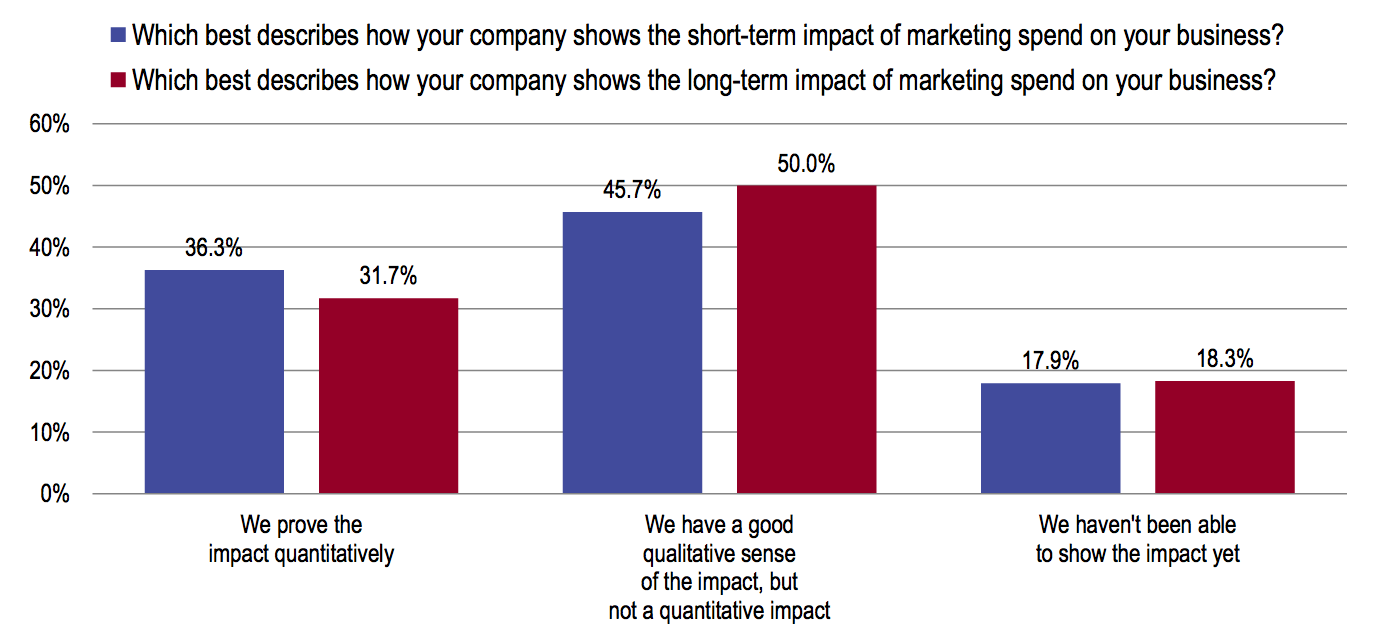
Marketing mix and spend modeling techniques had been battle-tested over last 30+ years. Despite its apparent popularity, results from a recent CMO survey highlights that most CMOs are still in the dark on assessing the impact of marketing spending.

Impact of Marketing Spending

Source: The CMO Survey, cmosurvey.org, August 2013

                 *****************************

Approx. 65% of CMOs are unable to quantify the business impact of a $1 increase or decrease in marketing spend.   Some suggestions to start a rational spend decisioning process:

  1. Think Omni-channel Spend Optimization First:  Your marketing and advertising budget has probably been increasing since 2008, and that growth has slowed to a trickle.   You migrated dollars to more “measurable” channels and new media – social, mobile, online.   To get the most bang from an initiative to quantify and maximize ROI, focus your investment on learning across channels (omni-channel or cross-channel) first, before you attempt to optimize each channel.
  2. Preempt CFO’s query:  If your CFO hasn’t asked yet, you are lucky but your luck will run out soon.   She would want to know the  ROI for each marketing and advertising tactic.  Further, with the street continuing to push for profitable growth in 2013 and beyond, you can’t go to the CFO for increase in budget, if you are unable to articulate the business case.  Do your homework and tell your CEO and CFO what you will deliver by changing your budget or allocating it more optimally across media, geographies, target market segments and marketing tactics.
  3. Hire Analytical Talent And Specialized Expertise:   To bring rigor to your marketing investment and allocation decision-making processes, upgrade your talent pool while mixing right-brained and left-brained individuals.