Category Archives: Marketing Analytics

Marketing Effectiveness and ROI: The Opportunity

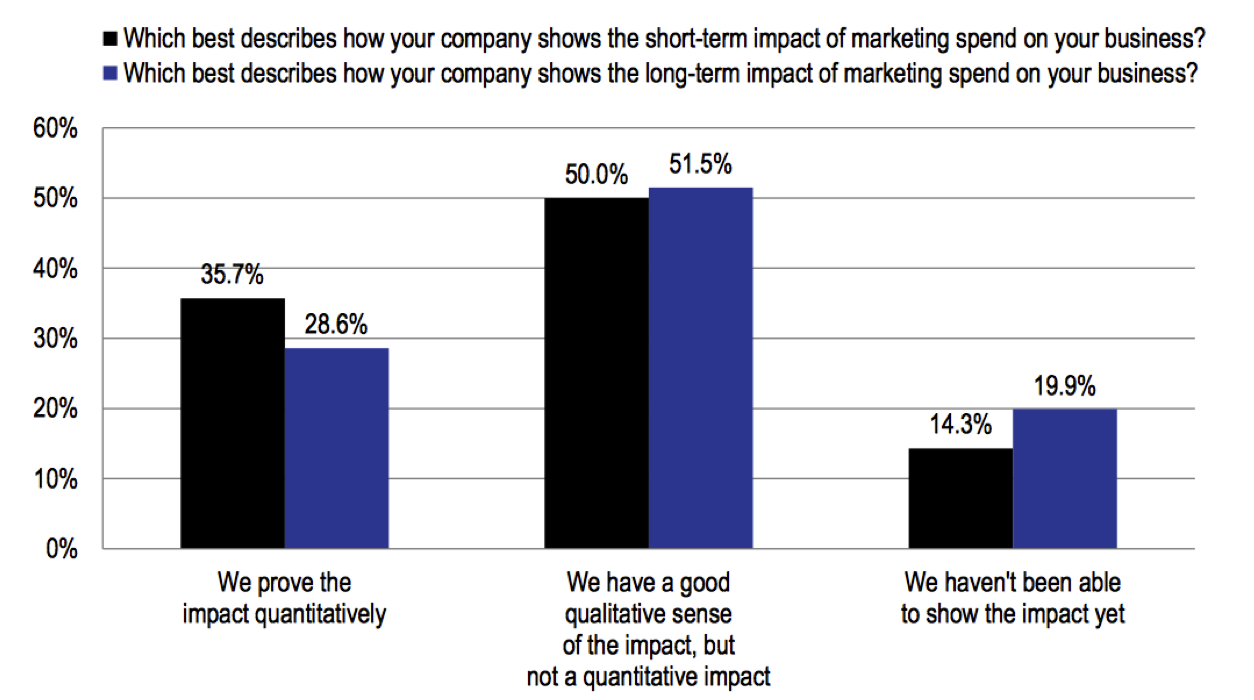
In the age of marketing accountability, one expects more CMOs to have quantitative and nuanced perspectives on what works, when, for which market segments, how, and why?   But the reality, as evidenced in a CMO survey, highlights a paradox and the opportunity for those who get the marketing effectiveness question right.  Only 1 in 3 marketers have a quantitative understanding of the impact of marketing spend, i.e., sales response function.
MarketingEffectiveness


Source: CMO Survey February 2014.

The Paradox:   When the same marketers are posed a question on Marketing ROI and how it has changed, CMOs appear confident in responding with a quantitative metric.    If you don’t have a sales response function, how can you venture an ROI?

***********************

Herein, lies the big opportunity for a select group of CMOs to stand out of the crowd, and befriend the CFO (one who obsesses with the real numbers that matter to any business), CTO (one who helps with ensuring that the technology platform and data exist), and CAO (one who can help make sense of the data in the business context and provide visibility into the future, even if it is blurry).
White-box or Black-box Marketing Analytics?

Many professional services firms claim to have proprietary (or black-box) frameworks and approaches to develop and execute business strategies.    Ability to anticipate the future, creativity, focus, discipline, and analytical horsepower are necessary conditions for business success.  A missing ingredient, for converting business strategies into executable plans and actions, requires organizations to be transparent, encourage healthy debates and challenge assumptions and internal biases, with a clear understanding of data-driven insights and associated limitations.

We are proponents of white-box analytics for the following reasons:

  1. Stories are more compelling than data:  To design new products and services, transform organizations, and build innovative business models, insights from data need to be synthesized into bite (or byte)-sized portions and woven into compelling stories to induce organizational and operational DNA mutations.
  2. Capability development for repeatable and reliable analytics:  The scientific principles underlying a white-box approach, permit internal teams to evaluate the analytical techniques in new contexts and with new data. This ensures development of repeatable systems and decision processes.  Even if you outsource select analytics initiatives, you have to develop internal capability to make core analytics a competitive differentiator and engine of continuous business success.
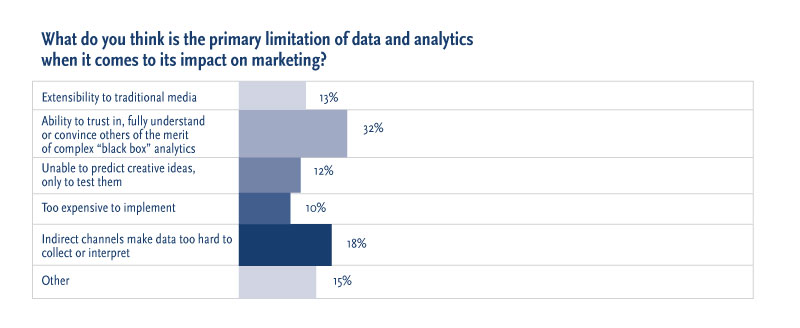
  3. Credibility and trustworthiness of data and approach:  Many CMOs don’t trust big data, analytics, and tools (see below).  Consequently, new ways of doing things are rarely internalized.  Enterprises must internalize and trust the data, analytics, and the underlying assumptions and context in which the insights are generated.  A white-box approach increases the odds of engendering trust, and insights and findings to permeate the organization – teams spread a key insight only if it is trustworthy.
  4. Continuous refinements to analytical techniques:  Often analytical approaches need to evolve as available data, types of data, consumer behaviors, and markets change.   Since these refinements need to be executed within the client’s organization, white-box approaches permit easier refinements – you can’t refine what you don’t understand.
  5. Better creative solutions:  White-box approaches typically favor a deeper understanding of “causes and effects” (“why” questions are more important than the “what” questions for strategic decisions) leading to more creative solutions to marketing strategy development and execution.

Source:  Big Data and the CMO: What’s Changing for Marketing Leadership? CMO Summit Survey Results, Spencer Stuart, April 2013.


Custom Technology Solution or Off-the-shelf Software Tool: Revisit Your Decisions

Over the years, given the perceived relative strengths of off-the-shelf software – faster, cheaper, better – compared to custom software, off-the-shelf software (enterprise or hosted) gained popularity.  But the advent of open-source platforms, infrastructure, and tools, has bent the cost curve for custom software, requiring organizations to rethink the custom versus off-the-shelf software decision.

  • Features that matter:  With off-the-shelf software – enterprise or software-as-a-service – you are stuck with the features the software maker provides, not the features that your unique business needs. Off-the-shelf software is either designed for a wide range of businesses across industries, or it is targeted to a particular industry.  In either case, you will need to adapt your decision systems and processes to the tool.
  • Competitive differentiation:  If you’re using off-the-shelf software, it is quite likely so are your competitors. Why would you choose to play on the same level playing field when you can develop advantages that are unique to your business, purpose, and organizational and operational strengths? Custom solution incorporates your proprietary insights and business processes, improving effectiveness and competitive advantage.  Every successful company has to be unique in the marketplace in or of more of the following: internal systems, processes, and decisions, external products, service, and operations.  In particular, for smarter marketing with data, associated uniqueness should be embedded into the data, analysis, or application of insights.  Consequently, there always will be considerable opportunity in custom software.
  • Continuous support and refinement:  Off-the-shelf software typically has basic level of support available with a support staff typically unable to understand the inherent intricacies of your business. With custom software you get in-depth support from an internal or an outsourced team who designed and developed the system.  As businesses and markets evolve, your needs change.  Custom software can adapt faster and more efficiently to your changing needs.   You may be stuck with what you have in off-the-shelf software. 
  • Higher ROI:  In our experience, you incur higher initial costs for design and development (though the cost premium is vanishing with the incorporation of open-source platforms and tools), and lower recurring costs for custom marketing analytics software, compared to off-the-shelf software.  But custom software can also deliver persistent incremental revenue premium.  Consequently, well-designed and implemented custom software solutions can deliver a greater return on investment.
  • Business application:  For basic plumbing and infrastructure go for the standard off-the-shelf and open source platforms and tools.  For simple analytics applications such as metrics and reporting, continue to adopt off-the-shelf apps.  But for predictive analytics, cause-effect analytics, and real-time marketing decision engines, you need custom software since this is the sweet spot for competitive differentiation: either in data or how data are consumed (I’ll expand on this topic in a future post).
  • Time to value:  Custom software, even with a scotch-tape approach built on top of open source platforms to (dis)prove a new way of thinking and doing, is often preferable to off-the-shelf software in terms of time to realize measurable business value.   It may not take a long time and internal resources to develop custom software, compared to even a decade back.  Rapid prototyping approaches have resulted in the development of great custom software quickly.
  • Maintenance:  With custom software hosted on the cloud, there are minimal ongoing costs associated with IT personnel.   Of course, there is need for data exchange – periodically in batch mode or continuously in real-time – between the business and the hosted solution provider.   But once the initial data integration hurdle is crossed, the rest is mostly business value generation.
  • Code ownership:  In a custom technology solution, the client owns the source code, except the modules embedding any proprietary algorithms of the system developer.

****************

We realize that the custom or off-the-shelf software decision is not an easy one.  But with the advent of open-source platforms and technologies, challenge the status quo, and revisit this important decision.