Many professional services firms claim to have proprietary (or black-box) frameworks and approaches to develop and execute business strategies. Ability to anticipate the future, creativity, focus, discipline, and analytical horsepower are necessary conditions for business success. A missing ingredient, for converting business strategies into executable plans and actions, requires organizations to be transparent, encourage healthy debates and challenge assumptions and internal biases, with a clear understanding of data-driven insights and associated limitations.
We are proponents of white-box analytics for the following reasons:
- Stories are more compelling than data: To design new products and services, transform organizations, and build innovative business models, insights from data need to be synthesized into bite (or byte)-sized portions and woven into compelling stories to induce organizational and operational DNA mutations.
- Capability development for repeatable and reliable analytics: The scientific principles underlying a white-box approach, permit internal teams to evaluate the analytical techniques in new contexts and with new data. This ensures development of repeatable systems and decision processes. Even if you outsource select analytics initiatives, you have to develop internal capability to make core analytics a competitive differentiator and engine of continuous business success.
- Credibility and trustworthiness of data and approach: Many CMOs don’t trust big data, analytics, and tools (see below). Consequently, new ways of doing things are rarely internalized. Enterprises must internalize and trust the data, analytics, and the underlying assumptions and context in which the insights are generated. A white-box approach increases the odds of engendering trust, and insights and findings to permeate the organization – teams spread a key insight only if it is trustworthy.
- Continuous refinements to analytical techniques: Often analytical approaches need to evolve as available data, types of data, consumer behaviors, and markets change. Since these refinements need to be executed within the client’s organization, white-box approaches permit easier refinements – you can’t refine what you don’t understand.
- Better creative solutions: White-box approaches typically favor a deeper understanding of “causes and effects” (“why” questions are more important than the “what” questions for strategic decisions) leading to more creative solutions to marketing strategy development and execution.
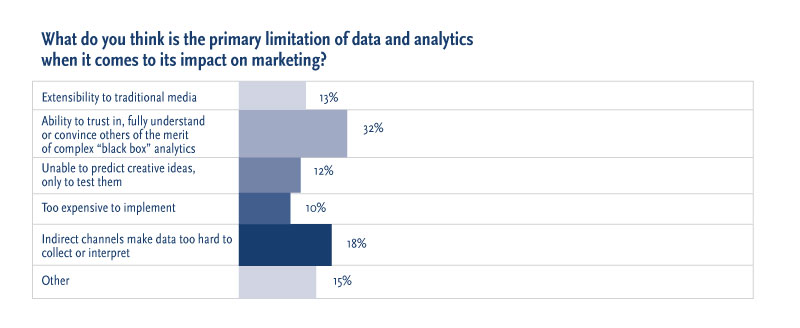
Source: Big Data and the CMO: What’s Changing for Marketing Leadership? CMO Summit Survey Results, Spencer Stuart, April 2013.