Monthly Archives: November 2013

White-box or Black-box Marketing Analytics?

Many professional services firms claim to have proprietary (or black-box) frameworks and approaches to develop and execute business strategies.    Ability to anticipate the future, creativity, focus, discipline, and analytical horsepower are necessary conditions for business success.  A missing ingredient, for converting business strategies into executable plans and actions, requires organizations to be transparent, encourage healthy debates and challenge assumptions and internal biases, with a clear understanding of data-driven insights and associated limitations.

We are proponents of white-box analytics for the following reasons:

  1. Stories are more compelling than data:  To design new products and services, transform organizations, and build innovative business models, insights from data need to be synthesized into bite (or byte)-sized portions and woven into compelling stories to induce organizational and operational DNA mutations.
  2. Capability development for repeatable and reliable analytics:  The scientific principles underlying a white-box approach, permit internal teams to evaluate the analytical techniques in new contexts and with new data. This ensures development of repeatable systems and decision processes.  Even if you outsource select analytics initiatives, you have to develop internal capability to make core analytics a competitive differentiator and engine of continuous business success.
  3. Credibility and trustworthiness of data and approach:  Many CMOs don’t trust big data, analytics, and tools (see below).  Consequently, new ways of doing things are rarely internalized.  Enterprises must internalize and trust the data, analytics, and the underlying assumptions and context in which the insights are generated.  A white-box approach increases the odds of engendering trust, and insights and findings to permeate the organization – teams spread a key insight only if it is trustworthy.
  4. Continuous refinements to analytical techniques:  Often analytical approaches need to evolve as available data, types of data, consumer behaviors, and markets change.   Since these refinements need to be executed within the client’s organization, white-box approaches permit easier refinements – you can’t refine what you don’t understand.
  5. Better creative solutions:  White-box approaches typically favor a deeper understanding of “causes and effects” (“why” questions are more important than the “what” questions for strategic decisions) leading to more creative solutions to marketing strategy development and execution.
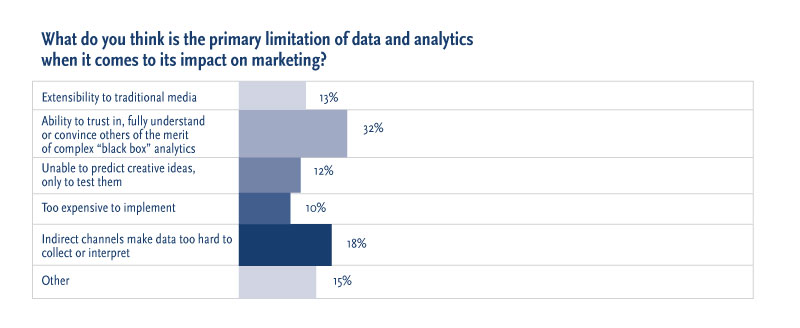
Source:  Big Data and the CMO: What’s Changing for Marketing Leadership? CMO Summit Survey Results, Spencer Stuart, April 2013.


From worst to best: What can businesses learn from the Boston Red Sox?

There are often lessons for business from popular culture, arts, and sports.  Here are some lessons from the 2013 Boston Red Sox World Series win.

  1. From tragedy to triumph:  On April 15, 2013, bombings near the finish line of the Boston Marathon killed three people and injured at least 250.  As Rahm Emanuel, Chicago Mayor and ex-White House Chief of Staff said: “You never let a serious crisis go to waste.”   Use your crises as learning moments and catalysts for change.  Also, pay careful attention post-crisis, since crises often lead to poor decisions under business stress.
  2. New leaders challenge the status quo:  With almost similar talent, a new leader, such as a calm, composed, and cerebral manager John Farrell, can make a huge difference.
  3. Visible symbols matter:  Almost all Boston Red Sox players sported ugly, scraggly, preposterous, and sometimes well-groomed beards.  But the beards unified the team in more ways than one.  Also note that the unifying beards didn’t happen at the start of the season.  Rather, they became more prominent midseason as more team members aligned on a shared purpose.
  4. Opportunity to rebuild your team:  Red Sox GM Ben Cherington signed the right players last offseason.  He didn’t have to bring aboard the biggest stars, but got his picks to contribute to winning.  A deftly crafted team with a diversity of skills, experiences, and perspectives will fight hard to succeed.
  5. Culture can change faster than you think:  Often organizational and operational DNA is a key driver of business success.  But there is the myth that cultural change is evolutionary and not revolutionary.  Select changes in a team – such as removal of bad apples swiftly – and bringing in fresh thinking can change the company’s culture faster than most expect, especially after going through a health crisis.
  6. Purpose beats singular focus on business:  It is not just about winning – after all who wants to lose.  But having a higher purpose – to help heal a city – mobilizes all your talent and resources to work together.  In a similar vein, businesses should give priority to a shared purpose – even ahead of business performance metrics such as revenues and margins.  Then, winning is just a by-product.
  7. Reallocate resources for transformational change:  It is easier to reallocate and optimize resources when you are at the bottom than when you are at the top.  Hitherto hard decisions become easy ones as there is less opposition to change and a new sense of urgency drives transformational change in organizations.

Big Data Quote of the Day: 11/01/2013

Quotes in Big Data’ Is Bunk, Obama Campaign’s Tech Guru Tells University Leaders:

“The ‘big’ there is purely marketing,” Mr. Reed said. “This is all fear … This is about you buying big expensive servers and whatnot.”

“The exciting thing is you can get a lot of this stuff done just in Excel,” he said. “You don’t need these big platforms. You don’t need all this big fancy stuff. If anyone says ‘big’ in front of it, you should look at them very skeptically … You can tell charlatans when they say ‘big’ in front of everything.”

**************

Yes, it is true that some data analysis can be done in Excel – for Small Data.   But you may need to process Big Data and synthesize , i.e., make it Small Data, before you can work with Excel.    The value arises from the art and science of data synthesis.

It doesn’t matter what tool you use to process the data.  The most important driver of business performance is whether you have an evidence-based or data-driven decision-making culture in your organization and operations.  If you haven’t used Small Data (survey data, transactional data, etc,.) for developing and executing strategies, and improving business performance in the past, you will be wasting money with your Big Data initiatives.