Category Archives: Evidence-based Decision

What is missing in ad tech?

Programmatic buying and precision targeting/marketing ecosystems are enjoying phenomenal growth, and is expected to capture 80% of the online display/mobile/video ad market by 2018.  It is just a matter of time (1-2 years) before the same buying principles/mechanism will capture bulk of TV, radio,  digital billboard, and other buys.   The digital ad technology stack is complex with stringent latency requirements for making a myriad of decisions within 10s of milliseconds.  But ad tech fails miserably in a very simple, but frequently occurring, use case:

  1. A shopper goes to an online retailer and considers some products, conducts some searches, etc.
  2. Shopper is interrupted by a tweet, a text, email about a breaking news story ( or a crying baby)
  3. Shopper goes to cnn.com to learn more.
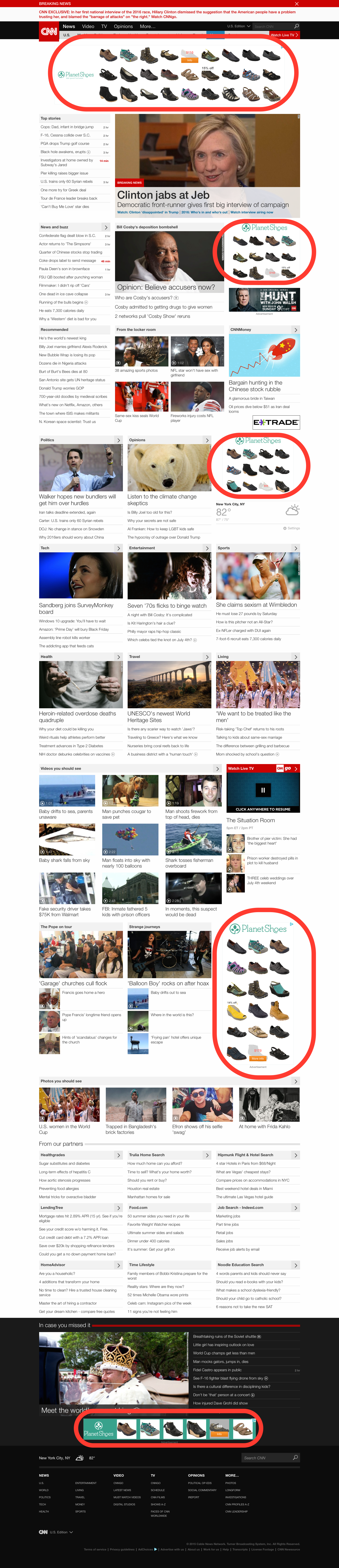
  4. Every ad on cnn.com is from the online retailer (see below from a recent personal experience).
fullpage

Naturally many questions arise in this mundane setting:

  • Conversion credit: Should the retargeting vendor (Criteo in this case) be credited with a conversion if a sale occurs?  Remember, my “other” tab still points to the retailer and I am actively shopping.
  • Overpayment: If it was an impression-based buy, then did the retailer pay Criteo unnecessarily? Maybe for 1 or 2 impression, but not for all 5.
  • Ecosystem complexity:  Criteo, after flexing its math muscle, determined that serving me a retargeted ad is economically advantageous (aka ROI) for the retailer and bid for the spot.  Criteo chanced to bid and win independently for each of the 5 spots on the same page.  Should Criteo be blamed for the situation? Note how each of the 5 spots hopped through multiple exchanges and networks as hot potatoes in milliseconds, while cnn.com is still serving up the page, all in parallel with 10s, 100s or 1000s of bidders bidding for each spot in real-time.  More importantly, Criteo can’t be sure whether it would win any, some, or all of the spots, or reliably know the ad page domain or URL (due to deliberate and accidental obfuscations inherent in the ecosystem).
  • Intent:  Every one thinks (or claims) that recency of behavioral markers plays a critical role in driving ad performance, but should the time dimension for intent be measured in seconds, minutes, hours or days?  It depends on many factors such as the product category, complexity of the consumer decision.  intent’s TTL/expiration, etc.


So what is missing in ad tech – common sense.  Ad ecosystem players are having heated and fruitless debates on viewability, transparency, and standardization of associated metrics (should online display viewability be measured as half the ad’s pixels potentially “viewable” for 1 second, half a video ad played, etc., which are similar to TV’s “opportunity to see” notions),  but I venture that the discussion should instead focus on:

  • Ad fraud (no one gains except the fraudsters)
  • Long-term and short-term impacts: Incremental brand  (will the buy influence and change the target’s perceptions of the brand) and ROI (will the target change behaviors) metrics vis-a-vis a “no buy.”

Airbnb’s new brand identity

airbnb

Airbnb just launched a new corporate brand identity as part of a broader overhaul of  its website and apps.    Yes, the visual identity and its link to a brand’s identity is very important.   As in any critical business decision, a combination of emotion (“gut” feelings and having a clear perspective) and data should inform the decision, and not by gut alone.   The co-founder of airbnb, Nathan Blecharczyk said:

We wouldn’t want to design a logo that caters to the lowest common denominator. This was a yearlong undertaking for dozens of people, it’s something meaningful, and no one pauses to really understand that.

Let’s calculate the approximate effort involved.  At least 12 team members with each team member at an average cost of $150K per year, translates into $1.8 million of valuable resources deployed for developing many ideas, sketches, before finally deciding on the “best” logo.    Ignore why airbnb felt the urge to change the logo in the first place, since the implementation costs of a new visual identify usually far exceeds its development – triggered by industry/company at an inflection point, arrival of a new CMO who feels the need to make a visible first impression (changing the logo, shuffling the roster of marketing and creative agencies, are often easier than changing the more important ROI trajectory or improving marketing-sales alignment).

In a P2P community-driven business such as airbnb, a crowd-sourced design and evaluation of logo could have provided many advantages:

  1. Outside-in:  Both hosts and renters, if influenced by the logo (and it is a valid “if”), have  opinions and perspectives on airbnb’s new visual identify and could have been willing co-creators of the visual identify.  Remember that in a switchboard business model such as airbnb’s, supply (hosts) and demand (renters) fuel revenues, and airbnb is only the enabler with a wonderful technology platform and user experience.  What matters is the the meaning and associations, if any, attached to the visual identity by hosts and renters.
  2. Lower costs of development:  Instead of expending close to $2 million, one an envision spending $50K or much less
  3. Better final solution:  More hearts and brains, with a diversity of perspectives and experiences, lead to a final solution.
  4. airbnb has influence and final say:  Even in a crowd-sourced approach, airbnb’s marketing team (and all employees) have the opportunity to participate and influence the evolution of the ideas, and internalize the meaning of the new visual identity.  This notion is powerful, if one of the goals of the change in the visual identify is to trigger a mutation of the organizational DNA.
  5. Insights from listening:   Just listening to the conversations among hosts, renters, and employees during the co-creation provides a wealth of insights about what matters (now and in the future) to the key constituencies to power future airbnb’s technology and product roadmap, improve customer/user experiences,  customer support operations, i.e., how to deliver on the brand promise and the future meaning of the visual identify.

Marketing Effectiveness and ROI: The Opportunity

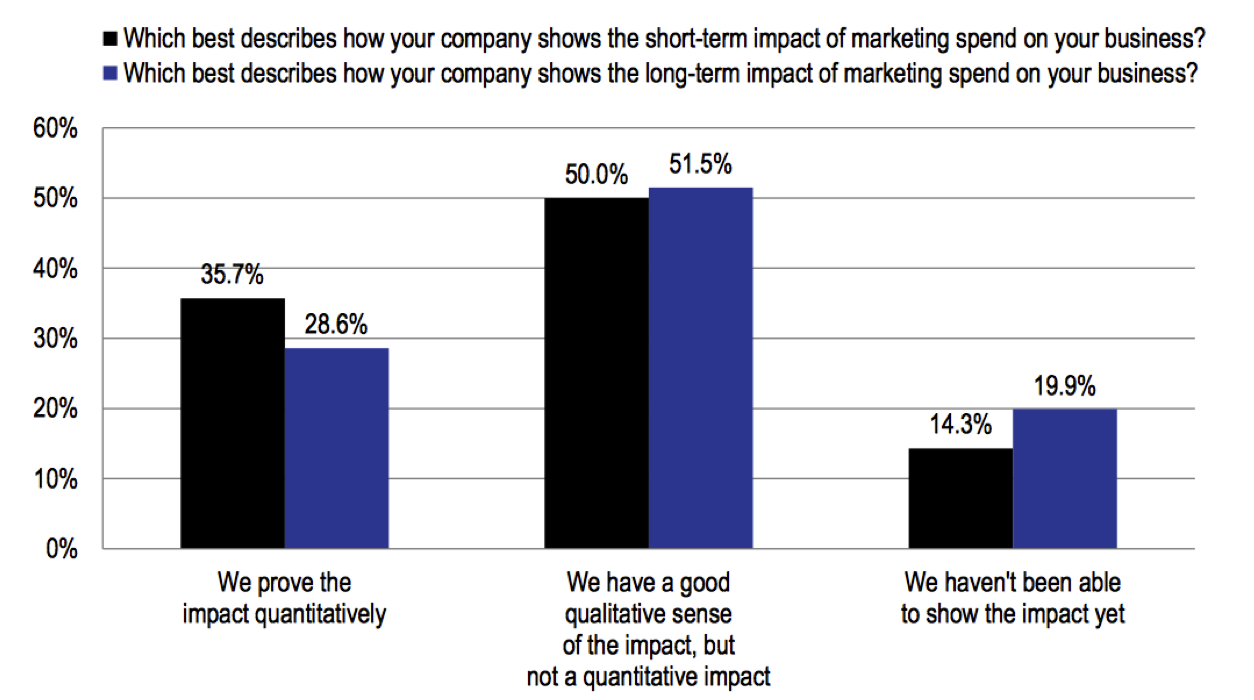
In the age of marketing accountability, one expects more CMOs to have quantitative and nuanced perspectives on what works, when, for which market segments, how, and why?   But the reality, as evidenced in a CMO survey, highlights a paradox and the opportunity for those who get the marketing effectiveness question right.  Only 1 in 3 marketers have a quantitative understanding of the impact of marketing spend, i.e., sales response function.

MarketingEffectiveness


Source: CMO Survey February 2014.

The Paradox:   When the same marketers are posed a question on Marketing ROI and how it has changed, CMOs appear confident in responding with a quantitative metric.    If you don’t have a sales response function, how can you venture an ROI?

***********************

Herein, lies the big opportunity for a select group of CMOs to stand out of the crowd, and befriend the CFO (one who obsesses with the real numbers that matter to any business), CTO (one who helps with ensuring that the technology platform and data exist), and CAO (one who can help make sense of the data in the business context and provide visibility into the future, even if it is blurry).

Marketing Effectiveness: Long-term versus short-term effect

In recent years, there has been a growing sentiment (supported by anecdotal evidence) that the long-term effects of advertising is diminishing.    Hypothesized causes include:

  1. Growing impact of digital and information availability in consumer shopping and search processes.
  2. Decreasing (product) brand loyalty.
  3. Consumer culture of “here and now” and fleeting consumer interests across product and shopping categories.
  4. Growing plethora of consumer choices in almost any product category.

A recent study conducted by Nielsen Catalina, Kellogg, and CBS concludes that the long-term effect – defined as total sales lift – range from 1.8 to 4.5 times the short-term sales lift.  Such estimates of long-term effects are even higher than similar assessments almost three decades back, further questioning anecdotal evidence.   The wide variation in long-term effects across brands and categories, further highlights the importance of precisely estimating and incorporating the effects in marketing investment optimization.

In order to tease out the long-term effects of advertising investments, we need more granular data on marketing investments within each media and marketing channel, and sales.

  1. Higher temporal resolution:  Hourly and daily marketing stimuli and investment data instead of typical weekly and monthly data.
  2. Improved spatial resolution:   Investments tracked across markets  – DMAs, states, etc.
  3. More precise targeting resolution:  Who is exposed to the advertising? visitors versus prospects versus customers?
  4. Disaggregate customer and sales data:  Sales from existing customers versus new customers? Conversions rates – prospect to new customer to repeat customer? Frequency of purchases by customer type?  Order value by customer type? Customer-level sales data?
  5. Test and control:   Often,  there is the need to design and execute structured experiments to generate the granular data for estimating long-term effects.
  6. Go beyond sales and profit:  To evaluate lasting effects of advertising, we need to marry brand tracking data with marketing effectiveness analysis.

Collating data spanning the upper and lower paths of the customer decision journey and statistically analyzing the interrelationships provides a stronger foundation for marketing investment decisions.


Big Data Quote of the Day: 11/01/2013

Quotes in Big Data’ Is Bunk, Obama Campaign’s Tech Guru Tells University Leaders:

“The ‘big’ there is purely marketing,” Mr. Reed said. “This is all fear … This is about you buying big expensive servers and whatnot.”

“The exciting thing is you can get a lot of this stuff done just in Excel,” he said. “You don’t need these big platforms. You don’t need all this big fancy stuff. If anyone says ‘big’ in front of it, you should look at them very skeptically … You can tell charlatans when they say ‘big’ in front of everything.”

**************

Yes, it is true that some data analysis can be done in Excel – for Small Data.   But you may need to process Big Data and synthesize , i.e., make it Small Data, before you can work with Excel.    The value arises from the art and science of data synthesis.

It doesn’t matter what tool you use to process the data.  The most important driver of business performance is whether you have an evidence-based or data-driven decision-making culture in your organization and operations.  If you haven’t used Small Data (survey data, transactional data, etc,.) for developing and executing strategies, and improving business performance in the past, you will be wasting money with your Big Data initiatives.