Monthly Archives: July 2014

Cloud computing and technology “platform” are passé

I just got back from Marketo’s Marketing Nation event.   Great presentation by Sanjay Dholakia (Marketo CMO) on the future of marketing, followed by practical and valuable tips from a B2B marketer (Marketo customer) from SmartBear software.      I ran into few  SaaS providers in the B2B ecosystem exhibiting at the event and noticed a common theme:

  1. Platform:    Exhibitors described themselves as a “platform” doing X, Y, and Z.    Some consolidated B2B data: public, private, web, and social media (of course, this is hard, requires non-trivial effort and shouldn’t be belittled), while others provided predictive analytics leveraging the data (incredibly valuable, but calling an analytical “engine” a platform is a stretch).
  2. Cloud:  Exhibitors emphasized how their software was in the “cloud” – no need for provisioning hardware, software maintenance, etc.    Sure when salesforce.com had to sell CRM software a decade back, referring to SaaS and cloud made sense because of the novelty effect.  But with significant innovations in marketing and ad technologies, where the software (and data) reside are less consequential for most marketers (select industries such as financial services, healthcare may think otherwise for many reasons).  What matters is how the “tools” help and guide the marketer make faster, smarter, and automated decisions with the goal of improving marketing ROI.

The pitches made by the exhibitors reminded me of a quote attributed to Michael Dell during the tech boom of early 2000 (paraphrased here):

If you put a bad business online, it is just an online bad business.

************************

We may want to stop talking about big data, cloud, platform, etc., as the terms don’t mean much to most marketers (nor should they care).   Instead focus on what “it” can do for the marketer and help outsmart the competition.
Predictive Analytics: Hype versus Reality

A quote in a recent PR release from Dresner Advisory Services, an industry analyst covering advanced and predictive analytics:

One clear conclusion we can draw is that there is a substantial gap in adoption of advanced and predictive analytics (A&PA) between the industry-messaging machine of vendors, media, and analysts, and the actual people who generate analytical output in organizations. While awareness of the importance of A&PA is high, adoption and practice are far from universal.

 *************************

Predictive analytics and associated techniques have been around for many decades (we used refer to such techniques as regression analysis – which, by the way, was developed in early 1800s, econometric modeling, or machine learning back then).   In the midst of all the euphoria about the business value of predictive analytics, it is our experience that marketers continue to struggle to operationalize the predictive models into day-to-day decisions.  We had one client whose internal decision sciences team built a complex but unusable model after a multi-month effort, but the model was never operationalized.   We developed a simpler but implementable model and integrated it into a decision-making software tool to guide and automate marketer’s decisions.


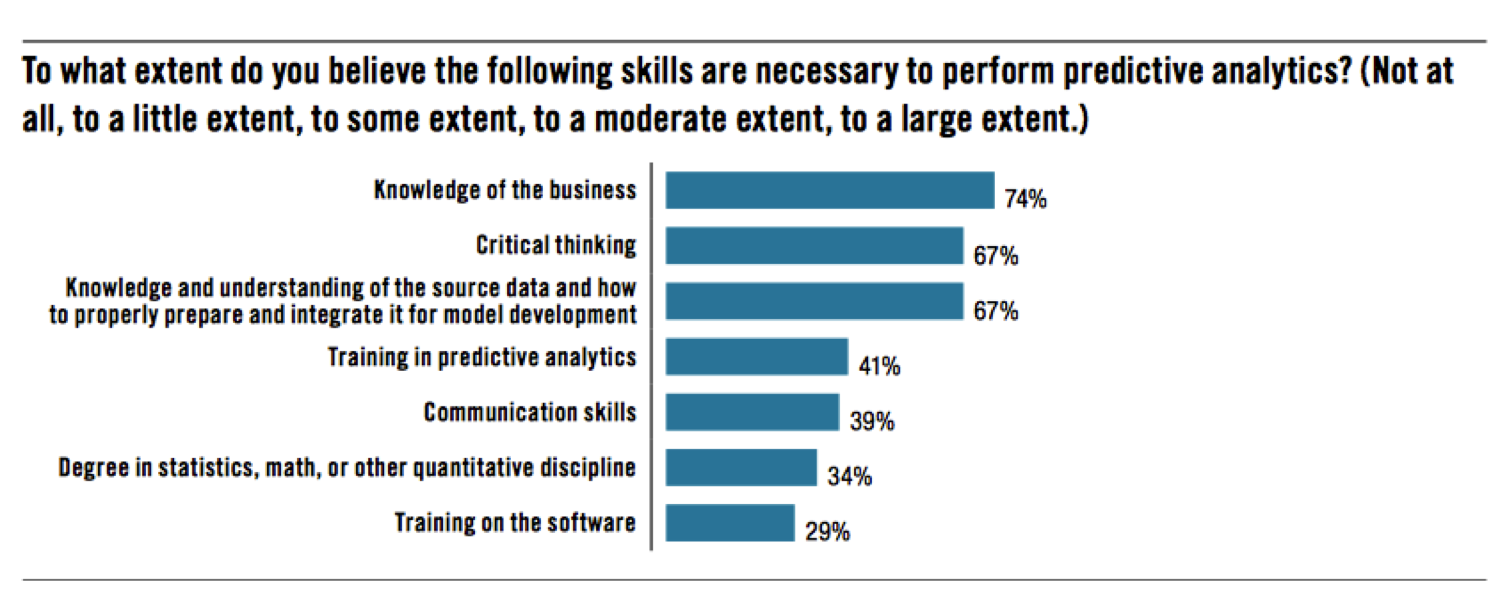
Chart of the Day: 07/19/2014

PredictiveAnalyticsSource: Predictive Analytics for Business Advantage, TDWI Research Report,  2014.

**************************

Having been involved in applying data and analytics to improve speed and quality of business decisions over the last 20+ years, I’ve observed that the best data scientist asks the “so what” question often and obsesses with operationalizing and automating business decisions  stemming from analytics using software, prior to even touching the data.  This often requires envisioning a new future  – modulated by organizational culture, people, and processes – and requisite changes needed for business success.

Big Data: Quote of the Day 07/19/2014

A quote in From Big Data to Deep Data caught my attention:


The real problem of big data is that we are increasingly outsourcing our capacity to sense and think to algorithms programmed into machines

*******************

That is the real benefit and not the problem.   Human beings find it almost impossible to identify meaningful patterns (i.e., sense and develop a perspective) in big data, without the guidance of algorithms, and find the proverbial  needle in the haystack.   Big data is usually great at making lots of little, but rational, decisions in a snap, while the human brain is great at making a big, usually non-rational (not irrational), and infrequent decision – deliberate and slow.   Creativity, imagination and judgment – hallmarks of our brain –  should be augmented with machine (or rational) intelligence, to get the most of big data.  Consequently, in the next two decades, you will see a decrease in the value of the left-brained data scientist (as algorithms get better at rational decisions) and increase in the value of the right-brained creative.

Airbnb’s new brand identity

airbnb

Airbnb just launched a new corporate brand identity as part of a broader overhaul of  its website and apps.    Yes, the visual identity and its link to a brand’s identity is very important.   As in any critical business decision, a combination of emotion (“gut” feelings and having a clear perspective) and data should inform the decision, and not by gut alone.   The co-founder of airbnb, Nathan Blecharczyk said:

We wouldn’t want to design a logo that caters to the lowest common denominator. This was a yearlong undertaking for dozens of people, it’s something meaningful, and no one pauses to really understand that.

Let’s calculate the approximate effort involved.  At least 12 team members with each team member at an average cost of $150K per year, translates into $1.8 million of valuable resources deployed for developing many ideas, sketches, before finally deciding on the “best” logo.    Ignore why airbnb felt the urge to change the logo in the first place, since the implementation costs of a new visual identify usually far exceeds its development – triggered by industry/company at an inflection point, arrival of a new CMO who feels the need to make a visible first impression (changing the logo, shuffling the roster of marketing and creative agencies, are often easier than changing the more important ROI trajectory or improving marketing-sales alignment).

In a P2P community-driven business such as airbnb, a crowd-sourced design and evaluation of logo could have provided many advantages:

  1. Outside-in:  Both hosts and renters, if influenced by the logo (and it is a valid “if”), have  opinions and perspectives on airbnb’s new visual identify and could have been willing co-creators of the visual identify.  Remember that in a switchboard business model such as airbnb’s, supply (hosts) and demand (renters) fuel revenues, and airbnb is only the enabler with a wonderful technology platform and user experience.  What matters is the the meaning and associations, if any, attached to the visual identity by hosts and renters.
  2. Lower costs of development:  Instead of expending close to $2 million, one an envision spending $50K or much less
  3. Better final solution:  More hearts and brains, with a diversity of perspectives and experiences, lead to a final solution.
  4. airbnb has influence and final say:  Even in a crowd-sourced approach, airbnb’s marketing team (and all employees) have the opportunity to participate and influence the evolution of the ideas, and internalize the meaning of the new visual identity.  This notion is powerful, if one of the goals of the change in the visual identify is to trigger a mutation of the organizational DNA.
  5. Insights from listening:   Just listening to the conversations among hosts, renters, and employees during the co-creation provides a wealth of insights about what matters (now and in the future) to the key constituencies to power future airbnb’s technology and product roadmap, improve customer/user experiences,  customer support operations, i.e., how to deliver on the brand promise and the future meaning of the visual identify.

Marketing Effectiveness and ROI: The Opportunity

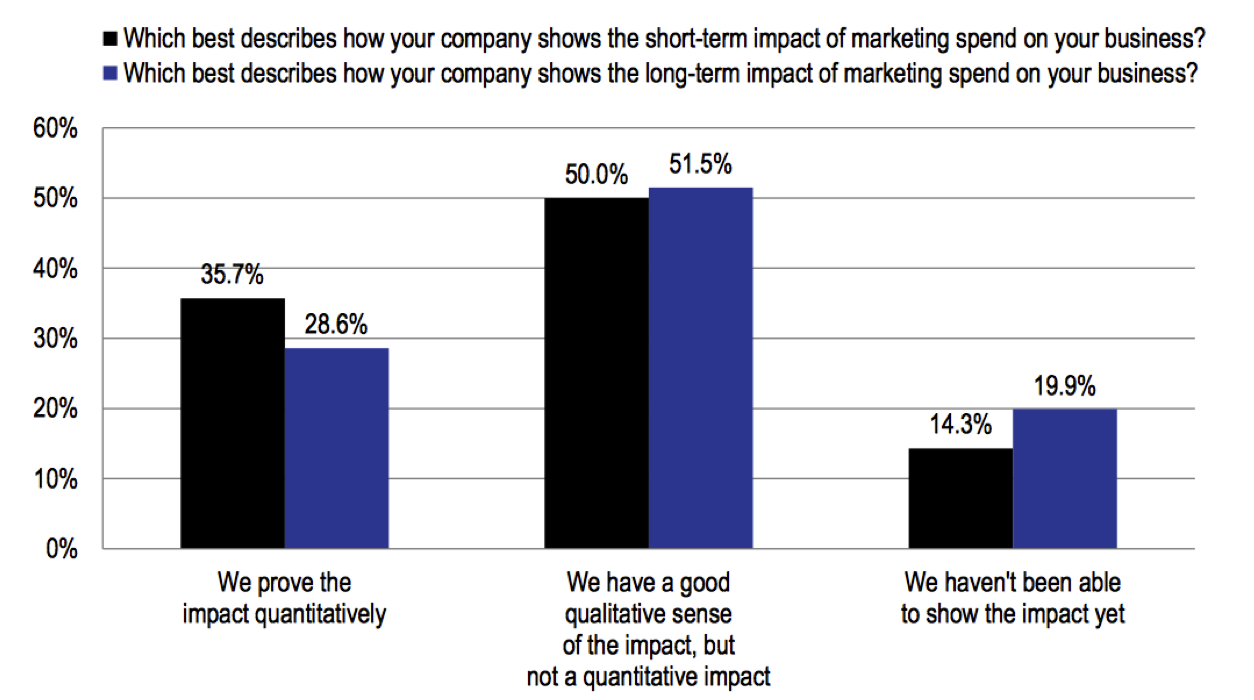
In the age of marketing accountability, one expects more CMOs to have quantitative and nuanced perspectives on what works, when, for which market segments, how, and why?   But the reality, as evidenced in a CMO survey, highlights a paradox and the opportunity for those who get the marketing effectiveness question right.  Only 1 in 3 marketers have a quantitative understanding of the impact of marketing spend, i.e., sales response function.

MarketingEffectiveness


Source: CMO Survey February 2014.

The Paradox:   When the same marketers are posed a question on Marketing ROI and how it has changed, CMOs appear confident in responding with a quantitative metric.    If you don’t have a sales response function, how can you venture an ROI?

***********************

Herein, lies the big opportunity for a select group of CMOs to stand out of the crowd, and befriend the CFO (one who obsesses with the real numbers that matter to any business), CTO (one who helps with ensuring that the technology platform and data exist), and CAO (one who can help make sense of the data in the business context and provide visibility into the future, even if it is blurry).