
Category Archives: Big Data

jet_front_page

Can Jet.com keep its promise of offering the lowest price for any product?

Jet.com officially launched yesterday.  The retailer can potentially shake up commerce as we know it.   Historically, retailers have focused on select control points for strategic differentiation.

  1. Location:  You have often heard of the “location, location, location” mantra in (offline) retailing.
  2. Selection:  Assortment, breadth of brands, categories, products, prices, focus on quality, etc.
  3. Customer service:  Imagine the experience of buying a bike at a local bike retailer versus buying one at one of the big stores.
  4. Price: EDLP, promotion-driving pricing, value-based pricing, etc.

With the growth of digital and advent of Amazon, additional dimensions of strategic competition and new competencies emerged:

  1. Data:  What does the retailer know about the shopper? Competition? Changing consumer mega and micro trends? Inventory levels?
  2. Algorithms and technology:  How does the retailer leverage aforementioned data to power applications on the demand side (personalized experiences, prices, promotions, offers, tracking, etc.) and the supply side (supply chain, operational efficiencies, drop shipments, etc.)?

Despite the hectic double-digit growth in e-commerce revenues worldwide, with the exception of select pricing innovations such as Priceline.com, e-commerce has remained largely unchanged in the last 20 years.   Jet.com could potentially change the status quo.  Jet.com has borrowed an old and simple idea from the membership model espoused by predominantly offline retailers such as Sam’s Club and Costco, where subscriptions drive retailer margins.  Add in a sprinkling of data, a dash of algorithms, and a shot of technology and Jet.com can revolutionize the consumer experience and become a formidable competitor.  The key strategic shift – imagine a retailer focused on finding  the best price for whatever the member would like to buy, i.e., “Jet.com works for our members.”   Jet.com, supposedly, will do the hard work of continuously monitoring prices, thus eliminating the search costs for consumers, and, for this benefit, the consumer is willing to pay an annual membership fee.  The CEO of Jet.com went a step further claiming that ad revenues (on Jet.com) from retail partners will be returned to Jet’s members by offering consumers even lower prices.

Then the key question is whether Jet.com can continuously monitor prices for any product and ensure that the price paid by its member is lower than any competitor at the time of purchase.  Anecdotal evidence suggests that this is a herculean task, and matters will only get worse as dynamic, personalized pricing (either determined by the retailer through algorithms or pay-what-you-wish pricing wherein the price paid is determined by the shopper) will be more commonplace (more on price differentiation in a later post).

I was looking to buy a sofa and decided to start with Jet.com.  Here is the snapshot of the product page on Jet.com.   It surfaced the Amazon price at $432.74 and Walmart.com price at $398.99, claiming an additional savings of approximately $24.   I moved on to check the prices at Walmart.com and Amazon.com  concurrently.
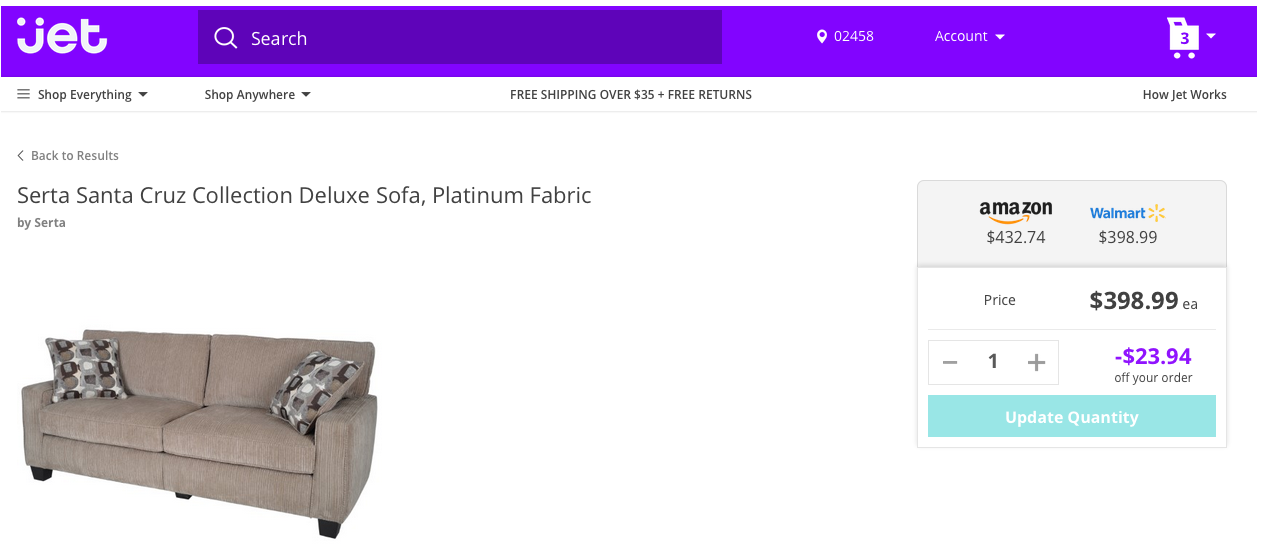
Product Page on Jet.com


On Amazon.com, a search lead to the exact product priced at $325, which is more than $100 below the Amazon’s price surfaced on Jet.com.   Strike 1.

Product Page on Amazon


On Walmart.com, the sofa was priced at $325, which is $75 below Walmart’s price surfaced on Jet.com.   Strike 2.
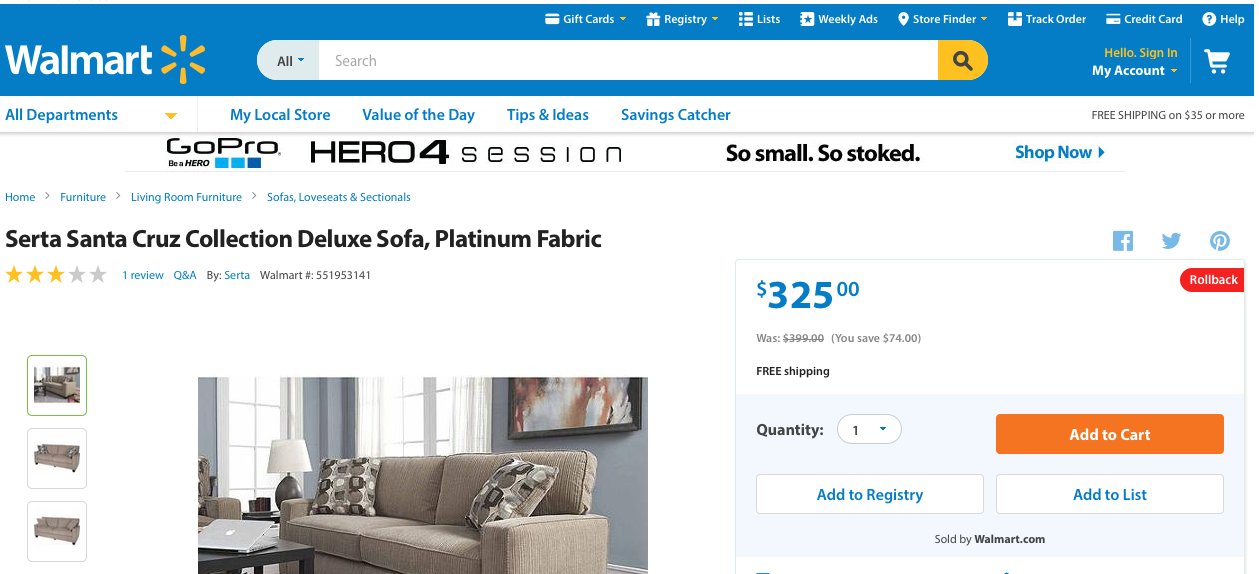
Product Page on Walmart


I am sure Jet.com tried its best to be on top of the prices at Amazon, Walmart and other retailers in its competitive set.  Probably the “crawl” of Amazon and Walmart sites was lagging behind by few hours or even a day, and Jet.com is presenting the latest prices as per its database.   But in a world of “dynamic” prices, when prices change every 10 minutes at sites such as Amazon, and the prices change could be dramatic (as seen in this anecdotal search), how can Jet.com promise to sell at or below lowest price of any other retailer (or  the fixed set of retailers it chooses to price monitor).  The truth will come out in coming weeks and months.

PS:  Note that I was searching for the sofa on the day of the “Black Friday in July” sale at Amazon (which Walmart copied with its own version of “Rollbacks”), and prices were oscillating at higher amplitude and frequency on that particular day and Jet.com’s system were lagging behind in its competitive price awareness more than on a typical day.  When the price discrepancy was raised with the support team at Jet.com, they responded immediately, and blamed it on Amazon’s sale and Walmart’s price matching efforts (note that Jet.com didn’t offer to sell me the sofa at $325).  Interestingly, Best Buy announced today that it will have a Black Friday sale starting Friday July 24, and even going a step further by offering a Cyber Monday.

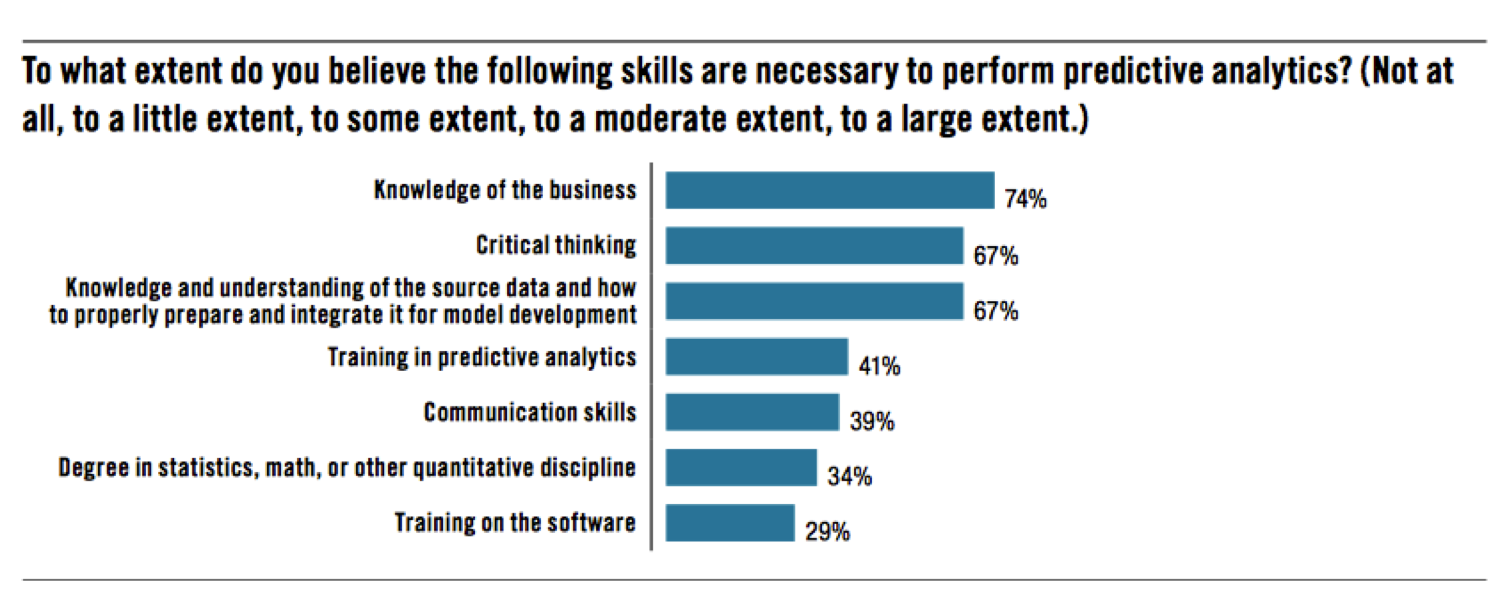
 

Chart of the Day: 07/19/2014

PredictiveAnalyticsSource: Predictive Analytics for Business Advantage, TDWI Research Report,  2014.

**************************

Having been involved in applying data and analytics to improve speed and quality of business decisions over the last 20+ years, I’ve observed that the best data scientist asks the “so what” question often and obsesses with operationalizing and automating business decisions  stemming from analytics using software, prior to even touching the data.  This often requires envisioning a new future  – modulated by organizational culture, people, and processes – and requisite changes needed for business success.

Big Data: Quote of the Day 07/19/2014

A quote in From Big Data to Deep Data caught my attention:


The real problem of big data is that we are increasingly outsourcing our capacity to sense and think to algorithms programmed into machines

*******************

That is the real benefit and not the problem.   Human beings find it almost impossible to identify meaningful patterns (i.e., sense and develop a perspective) in big data, without the guidance of algorithms, and find the proverbial  needle in the haystack.   Big data is usually great at making lots of little, but rational, decisions in a snap, while the human brain is great at making a big, usually non-rational (not irrational), and infrequent decision – deliberate and slow.   Creativity, imagination and judgment – hallmarks of our brain –  should be augmented with machine (or rational) intelligence, to get the most of big data.  Consequently, in the next two decades, you will see a decrease in the value of the left-brained data scientist (as algorithms get better at rational decisions) and increase in the value of the right-brained creative.

Big Data Quote of the Day: 11/01/2013

Quotes in Big Data’ Is Bunk, Obama Campaign’s Tech Guru Tells University Leaders:

“The ‘big’ there is purely marketing,” Mr. Reed said. “This is all fear … This is about you buying big expensive servers and whatnot.”

“The exciting thing is you can get a lot of this stuff done just in Excel,” he said. “You don’t need these big platforms. You don’t need all this big fancy stuff. If anyone says ‘big’ in front of it, you should look at them very skeptically … You can tell charlatans when they say ‘big’ in front of everything.”

**************

Yes, it is true that some data analysis can be done in Excel – for Small Data.   But you may need to process Big Data and synthesize , i.e., make it Small Data, before you can work with Excel.    The value arises from the art and science of data synthesis.

It doesn’t matter what tool you use to process the data.  The most important driver of business performance is whether you have an evidence-based or data-driven decision-making culture in your organization and operations.  If you haven’t used Small Data (survey data, transactional data, etc,.) for developing and executing strategies, and improving business performance in the past, you will be wasting money with your Big Data initiatives.

Business Value of Big Data Analytics

A recent Bain study suggests that  that early adopters of Big Data analytics have gained a significant lead over their competitors.  Bain studied 400+ large companies and found that those with most advanced analytics capabilities are outperforming competitors in more ways then one:  improved financial performance, faster decision-making, more effective execution, and adaptive  decisioning.

          *****************

It is often difficult to disentangle cause and effects –  companies achieved top performance in part due to advanced analytics or top performers are more likely to have an evidence-based organizational and operational DNA and leveraging analytics is just a manifestation of the underlying DNA.   But the positive correlations highlight the significant value potential of Big Data analytics stemming from improved speed and quality of decisions, and continuous refinements during execution.

Big Data Quote of the Day: 10/29/2013

An incredible and amusing quote from Sacramento Kings owner Vivek Ranadive on the Fox Business News today:

“Basketball is just a big data problem”

**************

What is next?  Is creating art just a Big Data problem?  Is becoming the fastest human just a Big Data problem?   Is the Grand Canyon tightrope crossing just a Big Data problem?  Is swimming from Cuba to Florida just a Big Data problem?

From Big Data to Business Value: No Silver Bullet

Self-proclaimed Big Data experts and management gurus, claim that you get to insight nirvana, often in few easy steps.    Just to cite some examples:

  1. Four Steps To Turn Big Data Into Action
  2. The seven steps of big data delivery | SAS
  3. Three Simple Steps to Big Data Intelligence – Crimson Hexagon
  4. Six Steps to Extract Value from Big Data – Datanami
  5. Steps to Start Your Big Data Journey
  6. Four Steps to Success with Big Data
  7. Steps for Tackling Big Data
  8. Steps to Better Big Data Insight
  9. Steps to Maximize the Potential of a Big Data Strategy
  10. Five first steps to creating an effective ‘big data‘ analytics program

And the list goes on…

*********************

Such proclamations lead to unmet expectations from analytics initiatives.  Going beyond insight and delivering measurable business impact requires discipline, focused effort, a sprinkling of luck, resiliency, a bout of creativity, and a dash of imagination.   After having lived more than two decades with data (often with large transactional databases and even raw web log data –  i.e., big data before it became a buzz word) of various shapes and sizes and their use in marketing and advertising decisions, my takeaways:

  • Analytics as a process is never linear since data analysis and insight generation is a never ending journey with many twists and u-turns.
  • Outcomes of the analysis can be unknown and even uncertain at the outset
  • Discipline and structured thinking are as important as embracing out-of-the-box thoughts and imaginations
  • Fortune favors the brave:    Luck plays a role while looking for the proverbial needle in the haystack.
  • Focus on the business goals and key questions since data and analytics will follow naturally.
  • Challenge the status quo:  Plan for required changes to”how things are done within the organization” based on what you may learn.
  • Anticipate internal and external opposition to change:  The biggest obstacle to realizing value from big data will come from organizational inertia.
  • Think system, processes and decision rights before data and analyses.
  • Patience is a virtue:   As Billie Jean King said: “Champions keep playing until they get it right.”

Big Data Quote of the Day 10/17/2013

An IBMer comments on a key impediment to internalization of Big Data insights into an organization’s DNA (from Big Data called “the planet’s new natural resource”)

“The hardest thing to overcome is the 30-year veteran who says, ‘You can’t tell me anything that my gut doesn’t already tell me.’ ”

********************

Again, it is not about big data, exabytes or yottabytes, unstructured data, NoSQL DBs, distributed computing, and analytics thereof.   It just comes down to human biases and  inertia.