Category Archives: ROI

Ad Blockers and Recent Hysteria in the Digital Ad Ecosystem

The online ad industry is in the midst of a healthy debate thanks to Apple’s recent moves in iOS 9 and latest Safari version.  Apple now supports blocking ads through third-party iOS apps (Purify, Crystal, and 1Blocker are few examples of such apps).  Apple makes miniscule ad revenues, claiming its iAd platform exists only to support app developers (also realizing that its core competence is in designing sleek, addictive, and interconnected consumer products).  With iOS 9, Apple began allowing customers to download and install ad-blocking apps starting the fierce debate.

Interestingly, consumers have had the opportunity to block ads in their web browsers for many years, but only a sliver of users did.  But in recent years, thanks to the innovations in ad formats, growth in mobile and video ads, more and more consumers are blocking ads.  IAB claims that 34% of online users have some type of ad blocking solution.  With Apple’s dominance in mobile devices, and the dramatic shift in consumer’s screen time to mobile, blocking ads is becoming easier than ever. And the ad blockers seem to work well for the most part (there is evidence that some legitimate publisher sites crash after the installation of ad blockers).

Naturally, ad tech companies, IAB, Google, Yahoo are crying foul.  Historically, ad blockers were free open source software.  Now ad blockers are attempting to monetize through two business models: an app install fee from the consumer (which seems fair since consumers choose to install and benefit from improved surfing experience) and/or charging advertisers/publishers for pass-through “good quality” ads (along with it comes notions of what is good quality since quality should be in the eyes of the consumer and not the publisher/advertiser).

Why do ad blockers exist in the first place?  Consumers are annoyed by irrelevant and intrusive ads (ads which take-over a site, automatic video plays, etc.) and concerned with security.  Mobile video ads consume scarce mobile bandwidth, worsen the browsing experience (a recent New York Times article claims that a Huffington Post article loads in 1.2 seconds without ads while it takes 5.2 seconds with ads), and decrease battery life. The charts associated with the NYT article highlight a revealing story of the relative mix of ad content and editorial in popular news sites.  Publishers need to reconsider the notion that their content is given away “free” to the consumer.  Content is never free, since the consumer is paying for it for bandwidth and service to the internet service provider.  For example, as per the same NYT article, viewing the home page of boston.com, the consumer pays a whopping $0.32 in terms of bandwidth costs.

Interestingly, given there is a real consumer need and associated value potential, ad blockers are also innovating with different mechanisms (and business models) for blocking ad content:

  • Browser-level:  This is the mechanism adopted by the oldest ad blockers which are installed as browser plugins/extensions. If you use multiple browsers, you will need to install the ad blocker for each browser.
  • Device-level:  The app based blockers spurred by iOS 9 correspond to software you install on the device, and the ad content is blocked by the blocker.  Interestingly, the ad blocker can’t block in-app ads (Apple is crafty and unwilling to antagonize its developer base).
  • Network-level:  As per a recent WSJ article, a small Israeli startup (Shine Technologies), blocks ads at the network level, and Caribbean-based wireless provider Digicel announced that it will start blocking ads reaching its subscribers by default.  Further, it will start charging for ads passed through. Digicel claims that about 10% of data consumed by its consumers is “ad content” (but the aforementioned NYT article suggests it is closer to 50%).  T-mobile is considering a similar network-level ad filtering in Europe.  From a consumer perspective, this is the easiest ad blocking solution (since it needs no installation of software).  Network players have large capital outlays to support unprecedented growth in data traffic, more wireless operators (and wired operators as well) will be pushing for this solution.  Network-level solutions will support some level of consumer control (through white-lists of publishers/advertisers). We expect to see significant migration of value in the ad ecosystem to network operators.

What should advertisers do? IAB claims that ad prices will have to pay premium prices in the future with a shrinking inventory.  We claim that advertisers should embrace ad blocking of any form. Why?  If a consumer does not want to be reached through ads, why should the advertiser pay to reach that consumer?  Ad tech firms biggest challenge, at least in a direct response advertising space, is identifying the consumer likely to “respond” to the ad.   If consumers opt-out of advertising, by design, they are also very unlikely to respond to ads.  Even ad tech firms should appreciate the notion that the ads won’t be served to non-responsive audience.  Ad blockers (partially) solve Wanamaker’s century-old advertising problem.

************************

Where are we heading?  Apple (Samsung and other mobile device manufacturers will follow) will win.   Advertisers will (unintentionally) win.  Google, ad networks, and publishers will lose.   Software-based ad blockers will thrive for a short while and ad value and power will shift to wired and wireless network operators embracing network-based ad blockers.

Publishers will be the ultimate losers, forcing them to develop a medley of mechanisms to monetize the content – beyond ads and subscriptions – personalized to each individual visit/visitor.  We expect new ad tech entrants to help publishers navigate the new world. Publishers will need tools to identify and inform users with ad blockers and educate them; also to deny content and permit adding the site to “white list” to consume the content, i.e., permit an acceptable value exchange between the publisher and a consumer.   Additionally, publishers will attempt to grow its native advertising (more on native advertising in a future post) to circumvent the ad blockers.

And as a byproduct of different ad blocking mechanisms, ad fraud will decrease, since more fraudulent “sites” and ads will become part of the dark web.  Consumers and advertisers rejoice!!!
Marketing Effectiveness and ROI: The Opportunity

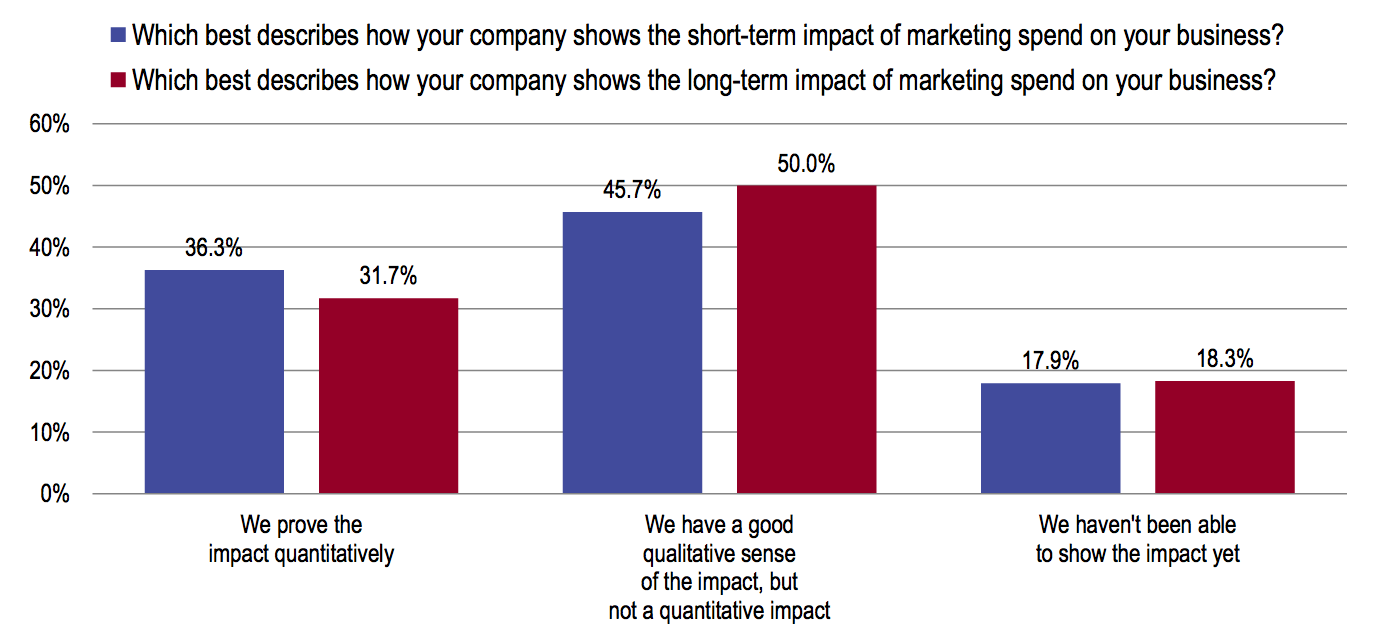
In the age of marketing accountability, one expects more CMOs to have quantitative and nuanced perspectives on what works, when, for which market segments, how, and why?   But the reality, as evidenced in a CMO survey, highlights a paradox and the opportunity for those who get the marketing effectiveness question right.  Only 1 in 3 marketers have a quantitative understanding of the impact of marketing spend, i.e., sales response function.

MarketingEffectiveness


Source: CMO Survey February 2014.

The Paradox:   When the same marketers are posed a question on Marketing ROI and how it has changed, CMOs appear confident in responding with a quantitative metric.    If you don’t have a sales response function, how can you venture an ROI?

***********************

Herein, lies the big opportunity for a select group of CMOs to stand out of the crowd, and befriend the CFO (one who obsesses with the real numbers that matter to any business), CTO (one who helps with ensuring that the technology platform and data exist), and CAO (one who can help make sense of the data in the business context and provide visibility into the future, even if it is blurry).

Marketing Effectiveness: Long-term versus short-term effect

In recent years, there has been a growing sentiment (supported by anecdotal evidence) that the long-term effects of advertising is diminishing.    Hypothesized causes include:

  1. Growing impact of digital and information availability in consumer shopping and search processes.
  2. Decreasing (product) brand loyalty.
  3. Consumer culture of “here and now” and fleeting consumer interests across product and shopping categories.
  4. Growing plethora of consumer choices in almost any product category.

A recent study conducted by Nielsen Catalina, Kellogg, and CBS concludes that the long-term effect – defined as total sales lift – range from 1.8 to 4.5 times the short-term sales lift.  Such estimates of long-term effects are even higher than similar assessments almost three decades back, further questioning anecdotal evidence.   The wide variation in long-term effects across brands and categories, further highlights the importance of precisely estimating and incorporating the effects in marketing investment optimization.

In order to tease out the long-term effects of advertising investments, we need more granular data on marketing investments within each media and marketing channel, and sales.

  1. Higher temporal resolution:  Hourly and daily marketing stimuli and investment data instead of typical weekly and monthly data.
  2. Improved spatial resolution:   Investments tracked across markets  – DMAs, states, etc.
  3. More precise targeting resolution:  Who is exposed to the advertising? visitors versus prospects versus customers?
  4. Disaggregate customer and sales data:  Sales from existing customers versus new customers? Conversions rates – prospect to new customer to repeat customer? Frequency of purchases by customer type?  Order value by customer type? Customer-level sales data?
  5. Test and control:   Often,  there is the need to design and execute structured experiments to generate the granular data for estimating long-term effects.
  6. Go beyond sales and profit:  To evaluate lasting effects of advertising, we need to marry brand tracking data with marketing effectiveness analysis.

Collating data spanning the upper and lower paths of the customer decision journey and statistically analyzing the interrelationships provides a stronger foundation for marketing investment decisions.


Buying Digital Ads Programmatically: Buyers Beware

Marketers need to be wary of ad tech peddlers claiming to buy ads one impression at a time through a real-time auction.    An interesting quote from Bill Lederer, CEO of MediaCrossing, a programmatic trader, highlights the state of programmatic buying.

“Some of this inventory being showcased as programmatic is being bought with a whole lot of phone calls and emails,” he said. “There’s a certain amount of phoniness in the discussion.”

*******************

Both direct and brand marketers will and must move dollars to programmatic ad buys for many reasons within digital media, and in the future as programmatic buying opens up for “traditional media” such as TV, but weigh the pros and cons carefully.  Reality is lagging well behind the hype.

Custom Technology Solution or Off-the-shelf Software Tool: Revisit Your Decisions

Over the years, given the perceived relative strengths of off-the-shelf software – faster, cheaper, better – compared to custom software, off-the-shelf software (enterprise or hosted) gained popularity.  But the advent of open-source platforms, infrastructure, and tools, has bent the cost curve for custom software, requiring organizations to rethink the custom versus off-the-shelf software decision.

  • Features that matter:  With off-the-shelf software – enterprise or software-as-a-service – you are stuck with the features the software maker provides, not the features that your unique business needs. Off-the-shelf software is either designed for a wide range of businesses across industries, or it is targeted to a particular industry.  In either case, you will need to adapt your decision systems and processes to the tool.
  • Competitive differentiation:  If you’re using off-the-shelf software, it is quite likely so are your competitors. Why would you choose to play on the same level playing field when you can develop advantages that are unique to your business, purpose, and organizational and operational strengths? Custom solution incorporates your proprietary insights and business processes, improving effectiveness and competitive advantage.  Every successful company has to be unique in the marketplace in or of more of the following: internal systems, processes, and decisions, external products, service, and operations.  In particular, for smarter marketing with data, associated uniqueness should be embedded into the data, analysis, or application of insights.  Consequently, there always will be considerable opportunity in custom software.
  • Continuous support and refinement:  Off-the-shelf software typically has basic level of support available with a support staff typically unable to understand the inherent intricacies of your business. With custom software you get in-depth support from an internal or an outsourced team who designed and developed the system.  As businesses and markets evolve, your needs change.  Custom software can adapt faster and more efficiently to your changing needs.   You may be stuck with what you have in off-the-shelf software. 
  • Higher ROI:  In our experience, you incur higher initial costs for design and development (though the cost premium is vanishing with the incorporation of open-source platforms and tools), and lower recurring costs for custom marketing analytics software, compared to off-the-shelf software.  But custom software can also deliver persistent incremental revenue premium.  Consequently, well-designed and implemented custom software solutions can deliver a greater return on investment.
  • Business application:  For basic plumbing and infrastructure go for the standard off-the-shelf and open source platforms and tools.  For simple analytics applications such as metrics and reporting, continue to adopt off-the-shelf apps.  But for predictive analytics, cause-effect analytics, and real-time marketing decision engines, you need custom software since this is the sweet spot for competitive differentiation: either in data or how data are consumed (I’ll expand on this topic in a future post).
  • Time to value:  Custom software, even with a scotch-tape approach built on top of open source platforms to (dis)prove a new way of thinking and doing, is often preferable to off-the-shelf software in terms of time to realize measurable business value.   It may not take a long time and internal resources to develop custom software, compared to even a decade back.  Rapid prototyping approaches have resulted in the development of great custom software quickly.
  • Maintenance:  With custom software hosted on the cloud, there are minimal ongoing costs associated with IT personnel.   Of course, there is need for data exchange – periodically in batch mode or continuously in real-time – between the business and the hosted solution provider.   But once the initial data integration hurdle is crossed, the rest is mostly business value generation.
  • Code ownership:  In a custom technology solution, the client owns the source code, except the modules embedding any proprietary algorithms of the system developer.

****************

We realize that the custom or off-the-shelf software decision is not an easy one.  But with the advent of open-source platforms and technologies, challenge the status quo, and revisit this important decision.


Business Impact of Marketing Spending: Don’t Be In the Dark

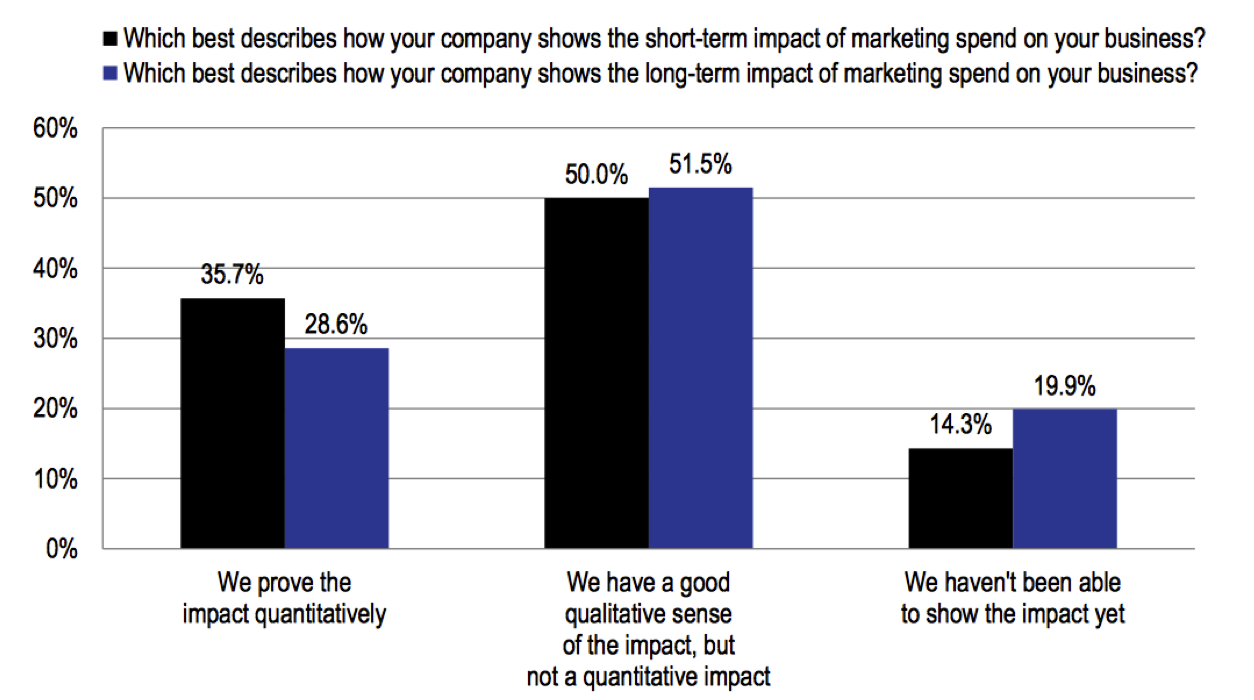
Marketing mix and spend modeling techniques had been battle-tested over last 30+ years. Despite its apparent popularity, results from a recent CMO survey highlights that most CMOs are still in the dark on assessing the impact of marketing spending.

Impact of Marketing Spending

Source: The CMO Survey, cmosurvey.org, August 2013

                 *****************************

Approx. 65% of CMOs are unable to quantify the business impact of a $1 increase or decrease in marketing spend.   Some suggestions to start a rational spend decisioning process:

  1. Think Omni-channel Spend Optimization First:  Your marketing and advertising budget has probably been increasing since 2008, and that growth has slowed to a trickle.   You migrated dollars to more “measurable” channels and new media – social, mobile, online.   To get the most bang from an initiative to quantify and maximize ROI, focus your investment on learning across channels (omni-channel or cross-channel) first, before you attempt to optimize each channel.
  2. Preempt CFO’s query:  If your CFO hasn’t asked yet, you are lucky but your luck will run out soon.   She would want to know the  ROI for each marketing and advertising tactic.  Further, with the street continuing to push for profitable growth in 2013 and beyond, you can’t go to the CFO for increase in budget, if you are unable to articulate the business case.  Do your homework and tell your CEO and CFO what you will deliver by changing your budget or allocating it more optimally across media, geographies, target market segments and marketing tactics.
  3. Hire Analytical Talent And Specialized Expertise:   To bring rigor to your marketing investment and allocation decision-making processes, upgrade your talent pool while mixing right-brained and left-brained individuals.