All posts by Dinesh Gopinath

Big Data Quote of the Day: 10/28/2013

From an article in SiSense ‘Breaks the Rules of Physics’ at Big Data Conference.

A new big data solution promises to do more than help businesses analyze massive amounts information. It’s actually “breaking the laws of physics,” said Eldad Farkash, co-founder and chief technology officer at SiSense.

Other notable phrases/quotes coming from the new physicists of Big Data.

  • Crowd-accelerated analytics: “Crowd accelerated analytics lets you analyze billions of rows of data in a flash
  • Power querying

**************

Again, more unbelievable magic in Big Data land.  Buyers beware.

Custom Technology Solution or Off-the-shelf Software Tool: Revisit Your Decisions

Over the years, given the perceived relative strengths of off-the-shelf software – faster, cheaper, better – compared to custom software, off-the-shelf software (enterprise or hosted) gained popularity.  But the advent of open-source platforms, infrastructure, and tools, has bent the cost curve for custom software, requiring organizations to rethink the custom versus off-the-shelf software decision.

  • Features that matter:  With off-the-shelf software – enterprise or software-as-a-service – you are stuck with the features the software maker provides, not the features that your unique business needs. Off-the-shelf software is either designed for a wide range of businesses across industries, or it is targeted to a particular industry.  In either case, you will need to adapt your decision systems and processes to the tool.
  • Competitive differentiation:  If you’re using off-the-shelf software, it is quite likely so are your competitors. Why would you choose to play on the same level playing field when you can develop advantages that are unique to your business, purpose, and organizational and operational strengths? Custom solution incorporates your proprietary insights and business processes, improving effectiveness and competitive advantage.  Every successful company has to be unique in the marketplace in or of more of the following: internal systems, processes, and decisions, external products, service, and operations.  In particular, for smarter marketing with data, associated uniqueness should be embedded into the data, analysis, or application of insights.  Consequently, there always will be considerable opportunity in custom software.
  • Continuous support and refinement:  Off-the-shelf software typically has basic level of support available with a support staff typically unable to understand the inherent intricacies of your business. With custom software you get in-depth support from an internal or an outsourced team who designed and developed the system.  As businesses and markets evolve, your needs change.  Custom software can adapt faster and more efficiently to your changing needs.   You may be stuck with what you have in off-the-shelf software. 
  • Higher ROI:  In our experience, you incur higher initial costs for design and development (though the cost premium is vanishing with the incorporation of open-source platforms and tools), and lower recurring costs for custom marketing analytics software, compared to off-the-shelf software.  But custom software can also deliver persistent incremental revenue premium.  Consequently, well-designed and implemented custom software solutions can deliver a greater return on investment.
  • Business application:  For basic plumbing and infrastructure go for the standard off-the-shelf and open source platforms and tools.  For simple analytics applications such as metrics and reporting, continue to adopt off-the-shelf apps.  But for predictive analytics, cause-effect analytics, and real-time marketing decision engines, you need custom software since this is the sweet spot for competitive differentiation: either in data or how data are consumed (I’ll expand on this topic in a future post).
  • Time to value:  Custom software, even with a scotch-tape approach built on top of open source platforms to (dis)prove a new way of thinking and doing, is often preferable to off-the-shelf software in terms of time to realize measurable business value.   It may not take a long time and internal resources to develop custom software, compared to even a decade back.  Rapid prototyping approaches have resulted in the development of great custom software quickly.
  • Maintenance:  With custom software hosted on the cloud, there are minimal ongoing costs associated with IT personnel.   Of course, there is need for data exchange – periodically in batch mode or continuously in real-time – between the business and the hosted solution provider.   But once the initial data integration hurdle is crossed, the rest is mostly business value generation.
  • Code ownership:  In a custom technology solution, the client owns the source code, except the modules embedding any proprietary algorithms of the system developer.

****************

We realize that the custom or off-the-shelf software decision is not an easy one.  But with the advent of open-source platforms and technologies, challenge the status quo, and revisit this important decision.


From Big Data to Business Value: No Silver Bullet

Self-proclaimed Big Data experts and management gurus, claim that you get to insight nirvana, often in few easy steps.    Just to cite some examples:

  1. Four Steps To Turn Big Data Into Action
  2. The seven steps of big data delivery | SAS
  3. Three Simple Steps to Big Data Intelligence – Crimson Hexagon
  4. Six Steps to Extract Value from Big Data – Datanami
  5. Steps to Start Your Big Data Journey
  6. Four Steps to Success with Big Data
  7. Steps for Tackling Big Data
  8. Steps to Better Big Data Insight
  9. Steps to Maximize the Potential of a Big Data Strategy
  10. Five first steps to creating an effective ‘big data‘ analytics program

And the list goes on…

*********************

Such proclamations lead to unmet expectations from analytics initiatives.  Going beyond insight and delivering measurable business impact requires discipline, focused effort, a sprinkling of luck, resiliency, a bout of creativity, and a dash of imagination.   After having lived more than two decades with data (often with large transactional databases and even raw web log data –  i.e., big data before it became a buzz word) of various shapes and sizes and their use in marketing and advertising decisions, my takeaways:

  • Analytics as a process is never linear since data analysis and insight generation is a never ending journey with many twists and u-turns.
  • Outcomes of the analysis can be unknown and even uncertain at the outset
  • Discipline and structured thinking are as important as embracing out-of-the-box thoughts and imaginations
  • Fortune favors the brave:    Luck plays a role while looking for the proverbial needle in the haystack.
  • Focus on the business goals and key questions since data and analytics will follow naturally.
  • Challenge the status quo:  Plan for required changes to”how things are done within the organization” based on what you may learn.
  • Anticipate internal and external opposition to change:  The biggest obstacle to realizing value from big data will come from organizational inertia.
  • Think system, processes and decision rights before data and analyses.
  • Patience is a virtue:   As Billie Jean King said: “Champions keep playing until they get it right.”

Business Impact of Marketing Spending: Don’t Be In the Dark

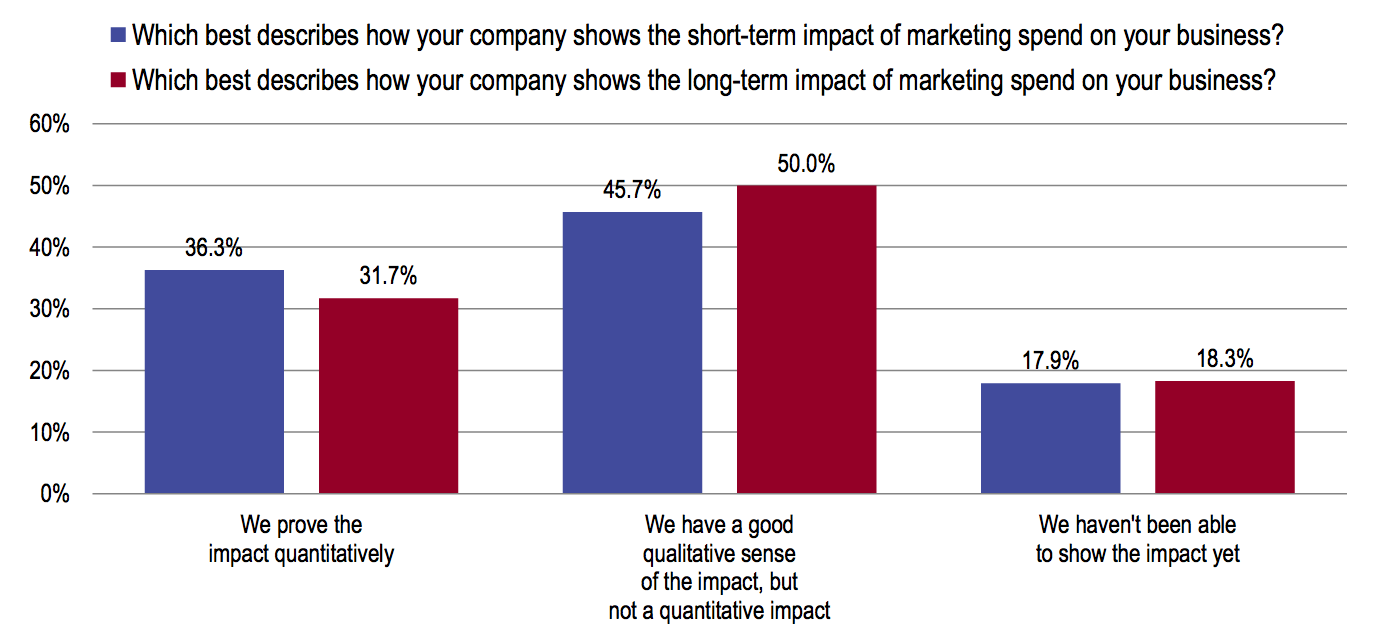
Marketing mix and spend modeling techniques had been battle-tested over last 30+ years. Despite its apparent popularity, results from a recent CMO survey highlights that most CMOs are still in the dark on assessing the impact of marketing spending.

Impact of Marketing Spending

Source: The CMO Survey, cmosurvey.org, August 2013

                 *****************************

Approx. 65% of CMOs are unable to quantify the business impact of a $1 increase or decrease in marketing spend.   Some suggestions to start a rational spend decisioning process:

  1. Think Omni-channel Spend Optimization First:  Your marketing and advertising budget has probably been increasing since 2008, and that growth has slowed to a trickle.   You migrated dollars to more “measurable” channels and new media – social, mobile, online.   To get the most bang from an initiative to quantify and maximize ROI, focus your investment on learning across channels (omni-channel or cross-channel) first, before you attempt to optimize each channel.
  2. Preempt CFO’s query:  If your CFO hasn’t asked yet, you are lucky but your luck will run out soon.   She would want to know the  ROI for each marketing and advertising tactic.  Further, with the street continuing to push for profitable growth in 2013 and beyond, you can’t go to the CFO for increase in budget, if you are unable to articulate the business case.  Do your homework and tell your CEO and CFO what you will deliver by changing your budget or allocating it more optimally across media, geographies, target market segments and marketing tactics.
  3. Hire Analytical Talent And Specialized Expertise:   To bring rigor to your marketing investment and allocation decision-making processes, upgrade your talent pool while mixing right-brained and left-brained individuals.


Big Data Quote of the Day 10/17/2013

An IBMer comments on a key impediment to internalization of Big Data insights into an organization’s DNA (from Big Data called “the planet’s new natural resource”)

“The hardest thing to overcome is the 30-year veteran who says, ‘You can’t tell me anything that my gut doesn’t already tell me.’ ”

********************

Again, it is not about big data, exabytes or yottabytes, unstructured data, NoSQL DBs, distributed computing, and analytics thereof.   It just comes down to human biases and  inertia.

Defining Big Data: Another “spin”

Big Data continues to be ambiguous to many that researchers and experts continue to refine and update what it is.   A recent research paper by Machina Research gives another spin – 5S of Big Data.

5S_Big_Data

The first four dimensions to characterize big data are variations of the 3Vs or 5Vs.  Significance is a dimension which caught my attention, since from my experience the relative value or importance of disparate data sources  vary significantly across types of business decisions – long-term versus short-term versus real-time, reactive versus proactive, marketing versus operational, human versus machine, strategic versus tactical, predictive versus causal, and business model shift versus continuous improvement.

   ***************************

The debate continues on how to define Big Data, while from my vantage point the discussion should center on the business value of data and  as an aid to improve the speed and quality of practical business decisions.  My mantra:

Ask not what it is.  Ask what it can do for you.

Big Data Generates Business Value – Outside Usual Suspects

There are very few demonstrated successes of big data at organizations excluding Amazon, Facebook, Netflix, Google, Twitter, etc,.   A recent article Big Data Success: 3 Companies Share Secrets in Information Week, highlights three companies (MetLife, British Airways, and Tivo Research Analytics) developing and implementing big data initiatives.   Some common themes:

  1. Size of data doesn’t matter.  Integrating data from different sources and “connecting the dots” can generate substantial business value.
  2. Time to value can be short.
  3. Business goal-driven big data project instead of data-driven big data project
  4. Business sense is as important as data sense.
  5. Perfection is the enemy of the good
  6. Simple analytics with creative data enrichment/fusion may beat advanced analytics on limited data.

It is heartening to read about such successes and business value generation instead of getting bogged down by how to define Big Data.

Defining “Big Data”

Given the confusing and varied interpretations of Big Data, couple of academics from University of St. Andrews, conducted a meta-analysis of extant definitions in a recent paper Undefined By Data: A Survey of Big Data Definitions.

1) Gartner:  three fold definition encompassing the “three Vs”: Volume, Velocity, Variety.

2) Oracle:  Derivation of value from traditional relational database augmented with new unstructured data sources.

3) Intel:  Links big data to organizations generating a median of 300TB of data weekly.

4) Microsoft: Process of applying serious computation power – latest in machine learning and AI – to seriously massive and complex sets of information.

5) Method for an Integrated Knowledge Environment project:  The high degree of permutations and interactions within a data set defines big data.

6) National Institute of Standards and Technology.  Data which exceed(s) the capacity or capability of current or conventional methods and systems.

The authors then attempt to coalesce these definitions and venture a new one:  Big data is a term describing the storage and analysis of large and or complex data sets using a series of techniques including, but not limited to:  NoSQL, MapReduce and machine learning.

                                                       *******************************

Instead of trying to define Big Data (a pointless exercise), focusing on what it can do (the value to businesses, consumers, and governments) is a more fruitful path to pursue.