Jet.com’s Pivot

Jet.com started out with a simple promise.  Lowest price for any product it sells.  It had a membership model ($50 annual membership fee) as the primary source of (net) revenues (akin to Costco and Sam’s club), and a simple goal of not losing money with each transaction.  Further it promised that more you buy, the more you save with its “smart cart pricing engine”.

Fast forward 10 weeks from launch, Jet.com pivots, and decides to do away with its membership model. Why?  There are few hypotheses:

  • Not the lowest prices after all:   Jet.com, in our analysis of competitive prices, was lower than Amazon prices by 3%-4% on average, but for 70%-80% of the products analyzed across select categories, Jet.com just matched Amazon prices, and not lower as per the marketing hype.   There is negligible price advantage buying at Jet.com for most transactions to compensate for the membership fees.  Other retailers also made aggressive moves by offering price match guarantees (Sears, Staples, Best Buy, Target, Walmart to name a few) have destroyed Jet’s lowest price positioning and Amazon responded by lowering its prices even further.
  • Limited breadth (across categories) and depth (selection, brands in each category): This needs no explanation.
  • Member acquisition hurdle: With limited selection and no price advantage, Amazon Prime (and Costco and Sam’s club) members have little reason to give up existing memberships or add Jet.com subscription.
  • Unsatisfactory UX:  Granted Jet.com is an upstart building a business, without reviews and recommendations which require shopper data, but could do better at designing for a better UX and not just the UI.

Now how will Jet.com make money?  It only has one secret sauce to highlight: “smart cart” pricing engine.   Otherwise, Jet.com is just another online retailer competing for your wallet.   Or will this pivot open the floodgates? Or will Jet.com position as a technology company by empowering brands, sellers, and shoppers with a marketplace better than Amazon and eBay (a non-trivial endeavor for a late entrant).

Ad Blockers and Recent Hysteria in the Digital Ad Ecosystem

The online ad industry is in the midst of a healthy debate thanks to Apple’s recent moves in iOS 9 and latest Safari version.  Apple now supports blocking ads through third-party iOS apps (Purify, Crystal, and 1Blocker are few examples of such apps).  Apple makes miniscule ad revenues, claiming its iAd platform exists only to support app developers (also realizing that its core competence is in designing sleek, addictive, and interconnected consumer products).  With iOS 9, Apple began allowing customers to download and install ad-blocking apps starting the fierce debate.

Interestingly, consumers have had the opportunity to block ads in their web browsers for many years, but only a sliver of users did.  But in recent years, thanks to the innovations in ad formats, growth in mobile and video ads, more and more consumers are blocking ads.  IAB claims that 34% of online users have some type of ad blocking solution.  With Apple’s dominance in mobile devices, and the dramatic shift in consumer’s screen time to mobile, blocking ads is becoming easier than ever. And the ad blockers seem to work well for the most part (there is evidence that some legitimate publisher sites crash after the installation of ad blockers).

Naturally, ad tech companies, IAB, Google, Yahoo are crying foul.  Historically, ad blockers were free open source software.  Now ad blockers are attempting to monetize through two business models: an app install fee from the consumer (which seems fair since consumers choose to install and benefit from improved surfing experience) and/or charging advertisers/publishers for pass-through “good quality” ads (along with it comes notions of what is good quality since quality should be in the eyes of the consumer and not the publisher/advertiser).

Why do ad blockers exist in the first place?  Consumers are annoyed by irrelevant and intrusive ads (ads which take-over a site, automatic video plays, etc.) and concerned with security.  Mobile video ads consume scarce mobile bandwidth, worsen the browsing experience (a recent New York Times article claims that a Huffington Post article loads in 1.2 seconds without ads while it takes 5.2 seconds with ads), and decrease battery life. The charts associated with the NYT article highlight a revealing story of the relative mix of ad content and editorial in popular news sites.  Publishers need to reconsider the notion that their content is given away “free” to the consumer.  Content is never free, since the consumer is paying for it for bandwidth and service to the internet service provider.  For example, as per the same NYT article, viewing the home page of boston.com, the consumer pays a whopping $0.32 in terms of bandwidth costs.

Interestingly, given there is a real consumer need and associated value potential, ad blockers are also innovating with different mechanisms (and business models) for blocking ad content:

  • Browser-level:  This is the mechanism adopted by the oldest ad blockers which are installed as browser plugins/extensions. If you use multiple browsers, you will need to install the ad blocker for each browser.
  • Device-level:  The app based blockers spurred by iOS 9 correspond to software you install on the device, and the ad content is blocked by the blocker.  Interestingly, the ad blocker can’t block in-app ads (Apple is crafty and unwilling to antagonize its developer base).
  • Network-level:  As per a recent WSJ article, a small Israeli startup (Shine Technologies), blocks ads at the network level, and Caribbean-based wireless provider Digicel announced that it will start blocking ads reaching its subscribers by default.  Further, it will start charging for ads passed through. Digicel claims that about 10% of data consumed by its consumers is “ad content” (but the aforementioned NYT article suggests it is closer to 50%).  T-mobile is considering a similar network-level ad filtering in Europe.  From a consumer perspective, this is the easiest ad blocking solution (since it needs no installation of software).  Network players have large capital outlays to support unprecedented growth in data traffic, more wireless operators (and wired operators as well) will be pushing for this solution.  Network-level solutions will support some level of consumer control (through white-lists of publishers/advertisers). We expect to see significant migration of value in the ad ecosystem to network operators.

What should advertisers do? IAB claims that ad prices will have to pay premium prices in the future with a shrinking inventory.  We claim that advertisers should embrace ad blocking of any form. Why?  If a consumer does not want to be reached through ads, why should the advertiser pay to reach that consumer?  Ad tech firms biggest challenge, at least in a direct response advertising space, is identifying the consumer likely to “respond” to the ad.   If consumers opt-out of advertising, by design, they are also very unlikely to respond to ads.  Even ad tech firms should appreciate the notion that the ads won’t be served to non-responsive audience.  Ad blockers (partially) solve Wanamaker’s century-old advertising problem.

************************

Where are we heading?  Apple (Samsung and other mobile device manufacturers will follow) will win.   Advertisers will (unintentionally) win.  Google, ad networks, and publishers will lose.   Software-based ad blockers will thrive for a short while and ad value and power will shift to wired and wireless network operators embracing network-based ad blockers.

Publishers will be the ultimate losers, forcing them to develop a medley of mechanisms to monetize the content – beyond ads and subscriptions – personalized to each individual visit/visitor.  We expect new ad tech entrants to help publishers navigate the new world. Publishers will need tools to identify and inform users with ad blockers and educate them; also to deny content and permit adding the site to “white list” to consume the content, i.e., permit an acceptable value exchange between the publisher and a consumer.   Additionally, publishers will attempt to grow its native advertising (more on native advertising in a future post) to circumvent the ad blockers.

And as a byproduct of different ad blocking mechanisms, ad fraud will decrease, since more fraudulent “sites” and ads will become part of the dark web.  Consumers and advertisers rejoice!!!
Ad Blockers: Interesting Quote

An insightful quote by Peter Imburg, founder and CEO of Elfster, a small social networking site for gift-giving, on the growing ad blocking phenomenon, in Ad Blocking – Unlike Fraud – Comes At The User’s Behest 

For many people, advertising is like a fly buzzing around in their face while they’re trying to do something.  Ad blocking might be akin to killing that fly with a sledgehammer, but it’s also “a wake-up call”

Imburg continued,

We need to try and solve the things that are annoying to our audience, whether it’s seeing too many ads or messages that make the page load too slowly or ads that take over the page. We need to solve those problems so ads become a feature of sites in the long tail – and not just an annoying way to generate revenue

******************

Thanks to Apple and its moves, the new ad tech battles have just started and the ad ecosystem will change forever.  Can you predict the winners and losers in the next two years?

What is missing in ad tech?

Programmatic buying and precision targeting/marketing ecosystems are enjoying phenomenal growth, and is expected to capture 80% of the online display/mobile/video ad market by 2018.  It is just a matter of time (1-2 years) before the same buying principles/mechanism will capture bulk of TV, radio,  digital billboard, and other buys.   The digital ad technology stack is complex with stringent latency requirements for making a myriad of decisions within 10s of milliseconds.  But ad tech fails miserably in a very simple, but frequently occurring, use case:

  1. A shopper goes to an online retailer and considers some products, conducts some searches, etc.
  2. Shopper is interrupted by a tweet, a text, email about a breaking news story ( or a crying baby)
  3. Shopper goes to cnn.com to learn more.
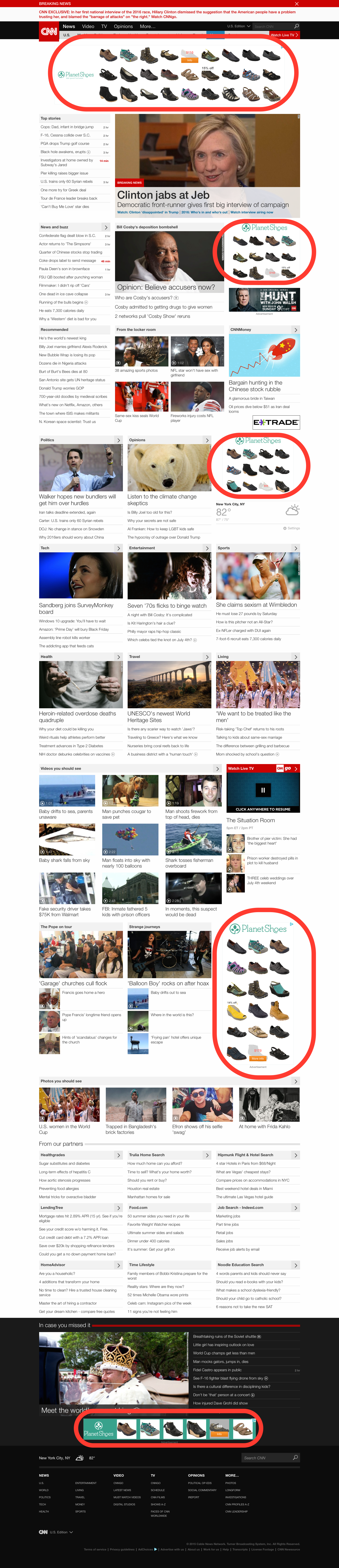
  4. Every ad on cnn.com is from the online retailer (see below from a recent personal experience).

fullpage

Naturally many questions arise in this mundane setting:

  • Conversion credit: Should the retargeting vendor (Criteo in this case) be credited with a conversion if a sale occurs?  Remember, my “other” tab still points to the retailer and I am actively shopping.
  • Overpayment: If it was an impression-based buy, then did the retailer pay Criteo unnecessarily? Maybe for 1 or 2 impression, but not for all 5.
  • Ecosystem complexity:  Criteo, after flexing its math muscle, determined that serving me a retargeted ad is economically advantageous (aka ROI) for the retailer and bid for the spot.  Criteo chanced to bid and win independently for each of the 5 spots on the same page.  Should Criteo be blamed for the situation? Note how each of the 5 spots hopped through multiple exchanges and networks as hot potatoes in milliseconds, while cnn.com is still serving up the page, all in parallel with 10s, 100s or 1000s of bidders bidding for each spot in real-time.  More importantly, Criteo can’t be sure whether it would win any, some, or all of the spots, or reliably know the ad page domain or URL (due to deliberate and accidental obfuscations inherent in the ecosystem).
  • Intent:  Every one thinks (or claims) that recency of behavioral markers plays a critical role in driving ad performance, but should the time dimension for intent be measured in seconds, minutes, hours or days?  It depends on many factors such as the product category, complexity of the consumer decision.  intent’s TTL/expiration, etc.


So what is missing in ad tech – common sense.  Ad ecosystem players are having heated and fruitless debates on viewability, transparency, and standardization of associated metrics (should online display viewability be measured as half the ad’s pixels potentially “viewable” for 1 second, half a video ad played, etc., which are similar to TV’s “opportunity to see” notions),  but I venture that the discussion should instead focus on:

  • Ad fraud (no one gains except the fraudsters)
  • Long-term and short-term impacts: Incremental brand  (will the buy influence and change the target’s perceptions of the brand) and ROI (will the target change behaviors) metrics vis-a-vis a “no buy.”
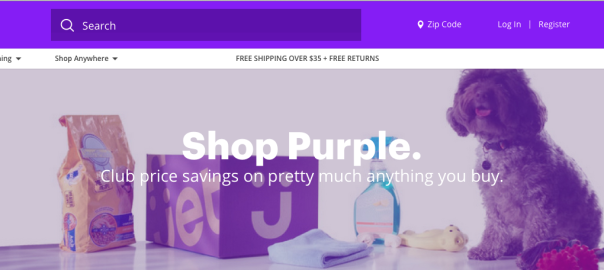
jet_front_page

Can Jet.com keep its promise of offering the lowest price for any product?

Jet.com officially launched yesterday.  The retailer can potentially shake up commerce as we know it.   Historically, retailers have focused on select control points for strategic differentiation.

  1. Location:  You have often heard of the “location, location, location” mantra in (offline) retailing.
  2. Selection:  Assortment, breadth of brands, categories, products, prices, focus on quality, etc.
  3. Customer service:  Imagine the experience of buying a bike at a local bike retailer versus buying one at one of the big stores.
  4. Price: EDLP, promotion-driving pricing, value-based pricing, etc.

With the growth of digital and advent of Amazon, additional dimensions of strategic competition and new competencies emerged:

  1. Data:  What does the retailer know about the shopper? Competition? Changing consumer mega and micro trends? Inventory levels?
  2. Algorithms and technology:  How does the retailer leverage aforementioned data to power applications on the demand side (personalized experiences, prices, promotions, offers, tracking, etc.) and the supply side (supply chain, operational efficiencies, drop shipments, etc.)?

Despite the hectic double-digit growth in e-commerce revenues worldwide, with the exception of select pricing innovations such as Priceline.com, e-commerce has remained largely unchanged in the last 20 years.   Jet.com could potentially change the status quo.  Jet.com has borrowed an old and simple idea from the membership model espoused by predominantly offline retailers such as Sam’s Club and Costco, where subscriptions drive retailer margins.  Add in a sprinkling of data, a dash of algorithms, and a shot of technology and Jet.com can revolutionize the consumer experience and become a formidable competitor.  The key strategic shift – imagine a retailer focused on finding  the best price for whatever the member would like to buy, i.e., “Jet.com works for our members.”   Jet.com, supposedly, will do the hard work of continuously monitoring prices, thus eliminating the search costs for consumers, and, for this benefit, the consumer is willing to pay an annual membership fee.  The CEO of Jet.com went a step further claiming that ad revenues (on Jet.com) from retail partners will be returned to Jet’s members by offering consumers even lower prices.

Then the key question is whether Jet.com can continuously monitor prices for any product and ensure that the price paid by its member is lower than any competitor at the time of purchase.  Anecdotal evidence suggests that this is a herculean task, and matters will only get worse as dynamic, personalized pricing (either determined by the retailer through algorithms or pay-what-you-wish pricing wherein the price paid is determined by the shopper) will be more commonplace (more on price differentiation in a later post).

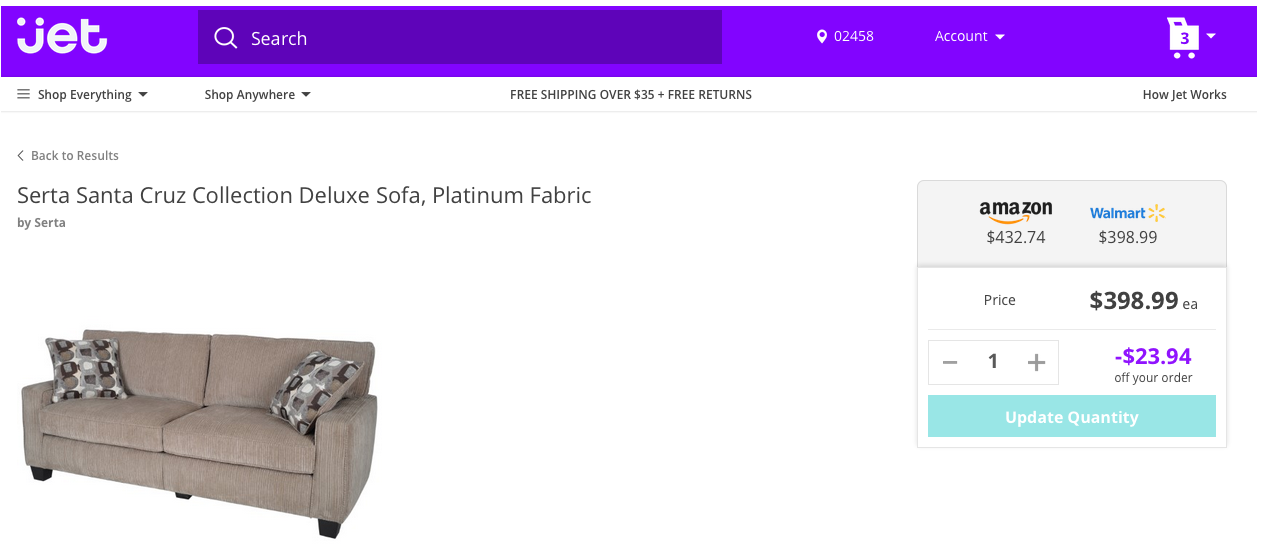
I was looking to buy a sofa and decided to start with Jet.com.  Here is the snapshot of the product page on Jet.com.   It surfaced the Amazon price at $432.74 and Walmart.com price at $398.99, claiming an additional savings of approximately $24.   I moved on to check the prices at Walmart.com and Amazon.com  concurrently.

Product Page on Jet.com


On Amazon.com, a search lead to the exact product priced at $325, which is more than $100 below the Amazon’s price surfaced on Jet.com.   Strike 1.

Product Page on Amazon


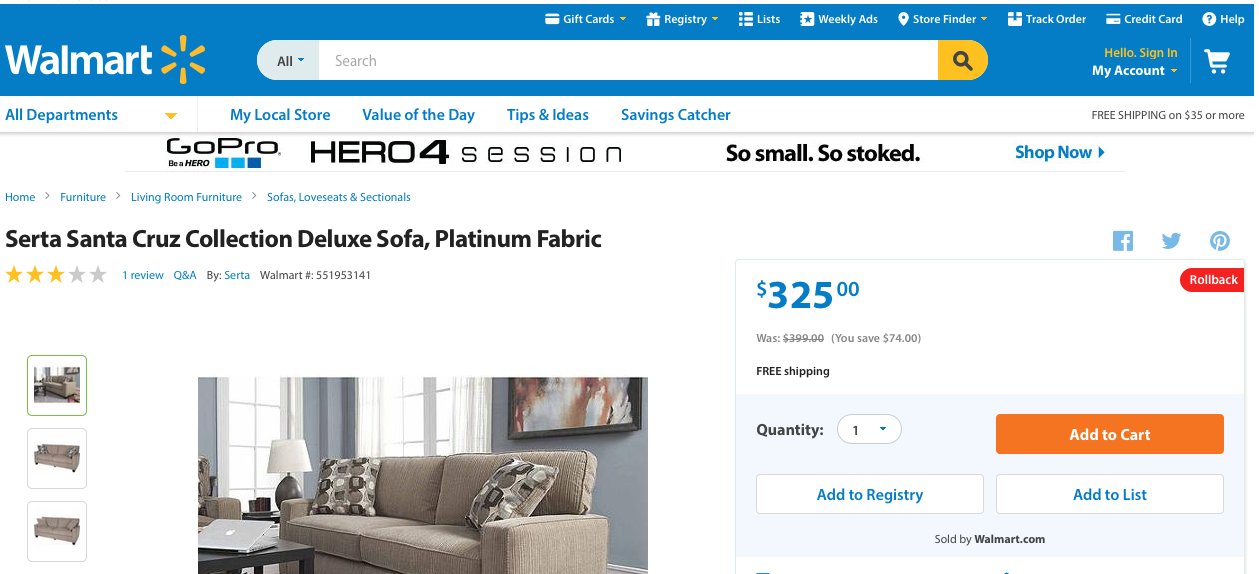
On Walmart.com, the sofa was priced at $325, which is $75 below Walmart’s price surfaced on Jet.com.   Strike 2.

Product Page on Walmart


I am sure Jet.com tried its best to be on top of the prices at Amazon, Walmart and other retailers in its competitive set.  Probably the “crawl” of Amazon and Walmart sites was lagging behind by few hours or even a day, and Jet.com is presenting the latest prices as per its database.   But in a world of “dynamic” prices, when prices change every 10 minutes at sites such as Amazon, and the prices change could be dramatic (as seen in this anecdotal search), how can Jet.com promise to sell at or below lowest price of any other retailer (or  the fixed set of retailers it chooses to price monitor).  The truth will come out in coming weeks and months.

PS:  Note that I was searching for the sofa on the day of the “Black Friday in July” sale at Amazon (which Walmart copied with its own version of “Rollbacks”), and prices were oscillating at higher amplitude and frequency on that particular day and Jet.com’s system were lagging behind in its competitive price awareness more than on a typical day.  When the price discrepancy was raised with the support team at Jet.com, they responded immediately, and blamed it on Amazon’s sale and Walmart’s price matching efforts (note that Jet.com didn’t offer to sell me the sofa at $325).  Interestingly, Best Buy announced today that it will have a Black Friday sale starting Friday July 24, and even going a step further by offering a Cyber Monday.


Cloud computing and technology “platform” are passé

I just got back from Marketo’s Marketing Nation event.   Great presentation by Sanjay Dholakia (Marketo CMO) on the future of marketing, followed by practical and valuable tips from a B2B marketer (Marketo customer) from SmartBear software.      I ran into few  SaaS providers in the B2B ecosystem exhibiting at the event and noticed a common theme:

  1. Platform:    Exhibitors described themselves as a “platform” doing X, Y, and Z.    Some consolidated B2B data: public, private, web, and social media (of course, this is hard, requires non-trivial effort and shouldn’t be belittled), while others provided predictive analytics leveraging the data (incredibly valuable, but calling an analytical “engine” a platform is a stretch).
  2. Cloud:  Exhibitors emphasized how their software was in the “cloud” – no need for provisioning hardware, software maintenance, etc.    Sure when salesforce.com had to sell CRM software a decade back, referring to SaaS and cloud made sense because of the novelty effect.  But with significant innovations in marketing and ad technologies, where the software (and data) reside are less consequential for most marketers (select industries such as financial services, healthcare may think otherwise for many reasons).  What matters is how the “tools” help and guide the marketer make faster, smarter, and automated decisions with the goal of improving marketing ROI.

The pitches made by the exhibitors reminded me of a quote attributed to Michael Dell during the tech boom of early 2000 (paraphrased here):

If you put a bad business online, it is just an online bad business.

************************

We may want to stop talking about big data, cloud, platform, etc., as the terms don’t mean much to most marketers (nor should they care).   Instead focus on what “it” can do for the marketer and help outsmart the competition.

Predictive Analytics: Hype versus Reality

A quote in a recent PR release from Dresner Advisory Services, an industry analyst covering advanced and predictive analytics:

One clear conclusion we can draw is that there is a substantial gap in adoption of advanced and predictive analytics (A&PA) between the industry-messaging machine of vendors, media, and analysts, and the actual people who generate analytical output in organizations. While awareness of the importance of A&PA is high, adoption and practice are far from universal.

 *************************

Predictive analytics and associated techniques have been around for many decades (we used refer to such techniques as regression analysis – which, by the way, was developed in early 1800s, econometric modeling, or machine learning back then).   In the midst of all the euphoria about the business value of predictive analytics, it is our experience that marketers continue to struggle to operationalize the predictive models into day-to-day decisions.  We had one client whose internal decision sciences team built a complex but unusable model after a multi-month effort, but the model was never operationalized.   We developed a simpler but implementable model and integrated it into a decision-making software tool to guide and automate marketer’s decisions.


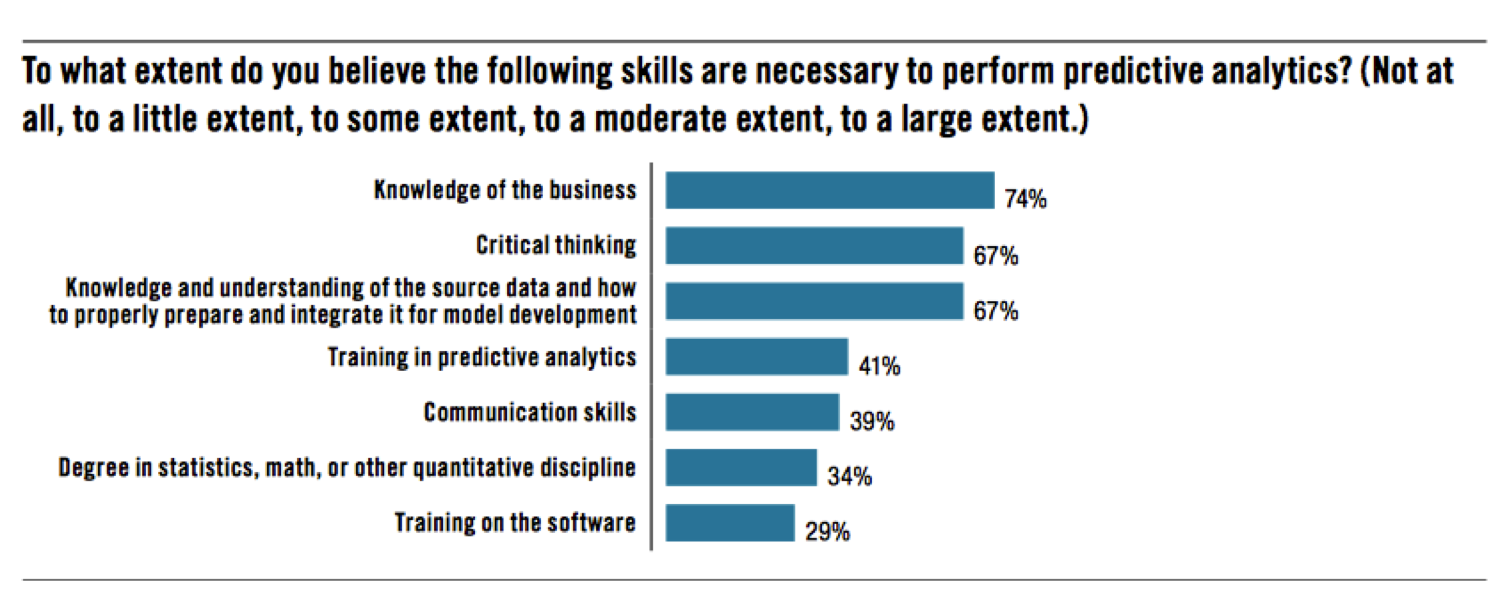
Chart of the Day: 07/19/2014

PredictiveAnalyticsSource: Predictive Analytics for Business Advantage, TDWI Research Report,  2014.

**************************

Having been involved in applying data and analytics to improve speed and quality of business decisions over the last 20+ years, I’ve observed that the best data scientist asks the “so what” question often and obsesses with operationalizing and automating business decisions  stemming from analytics using software, prior to even touching the data.  This often requires envisioning a new future  – modulated by organizational culture, people, and processes – and requisite changes needed for business success.

Big Data: Quote of the Day 07/19/2014

A quote in From Big Data to Deep Data caught my attention:


The real problem of big data is that we are increasingly outsourcing our capacity to sense and think to algorithms programmed into machines

*******************

That is the real benefit and not the problem.   Human beings find it almost impossible to identify meaningful patterns (i.e., sense and develop a perspective) in big data, without the guidance of algorithms, and find the proverbial  needle in the haystack.   Big data is usually great at making lots of little, but rational, decisions in a snap, while the human brain is great at making a big, usually non-rational (not irrational), and infrequent decision – deliberate and slow.   Creativity, imagination and judgment – hallmarks of our brain –  should be augmented with machine (or rational) intelligence, to get the most of big data.  Consequently, in the next two decades, you will see a decrease in the value of the left-brained data scientist (as algorithms get better at rational decisions) and increase in the value of the right-brained creative.