
Airbnb’s new brand identity

airbnb

Airbnb just launched a new corporate brand identity as part of a broader overhaul of  its website and apps.    Yes, the visual identity and its link to a brand’s identity is very important.   As in any critical business decision, a combination of emotion (“gut” feelings and having a clear perspective) and data should inform the decision, and not by gut alone.   The co-founder of airbnb, Nathan Blecharczyk said:

We wouldn’t want to design a logo that caters to the lowest common denominator. This was a yearlong undertaking for dozens of people, it’s something meaningful, and no one pauses to really understand that.

Let’s calculate the approximate effort involved.  At least 12 team members with each team member at an average cost of $150K per year, translates into $1.8 million of valuable resources deployed for developing many ideas, sketches, before finally deciding on the “best” logo.    Ignore why airbnb felt the urge to change the logo in the first place, since the implementation costs of a new visual identify usually far exceeds its development – triggered by industry/company at an inflection point, arrival of a new CMO who feels the need to make a visible first impression (changing the logo, shuffling the roster of marketing and creative agencies, are often easier than changing the more important ROI trajectory or improving marketing-sales alignment).

In a P2P community-driven business such as airbnb, a crowd-sourced design and evaluation of logo could have provided many advantages:

  1. Outside-in:  Both hosts and renters, if influenced by the logo (and it is a valid “if”), have  opinions and perspectives on airbnb’s new visual identify and could have been willing co-creators of the visual identify.  Remember that in a switchboard business model such as airbnb’s, supply (hosts) and demand (renters) fuel revenues, and airbnb is only the enabler with a wonderful technology platform and user experience.  What matters is the the meaning and associations, if any, attached to the visual identity by hosts and renters.
  2. Lower costs of development:  Instead of expending close to $2 million, one an envision spending $50K or much less
  3. Better final solution:  More hearts and brains, with a diversity of perspectives and experiences, lead to a final solution.
  4. airbnb has influence and final say:  Even in a crowd-sourced approach, airbnb’s marketing team (and all employees) have the opportunity to participate and influence the evolution of the ideas, and internalize the meaning of the new visual identity.  This notion is powerful, if one of the goals of the change in the visual identify is to trigger a mutation of the organizational DNA.
  5. Insights from listening:   Just listening to the conversations among hosts, renters, and employees during the co-creation provides a wealth of insights about what matters (now and in the future) to the key constituencies to power future airbnb’s technology and product roadmap, improve customer/user experiences,  customer support operations, i.e., how to deliver on the brand promise and the future meaning of the visual identify.
Marketing Effectiveness and ROI: The Opportunity

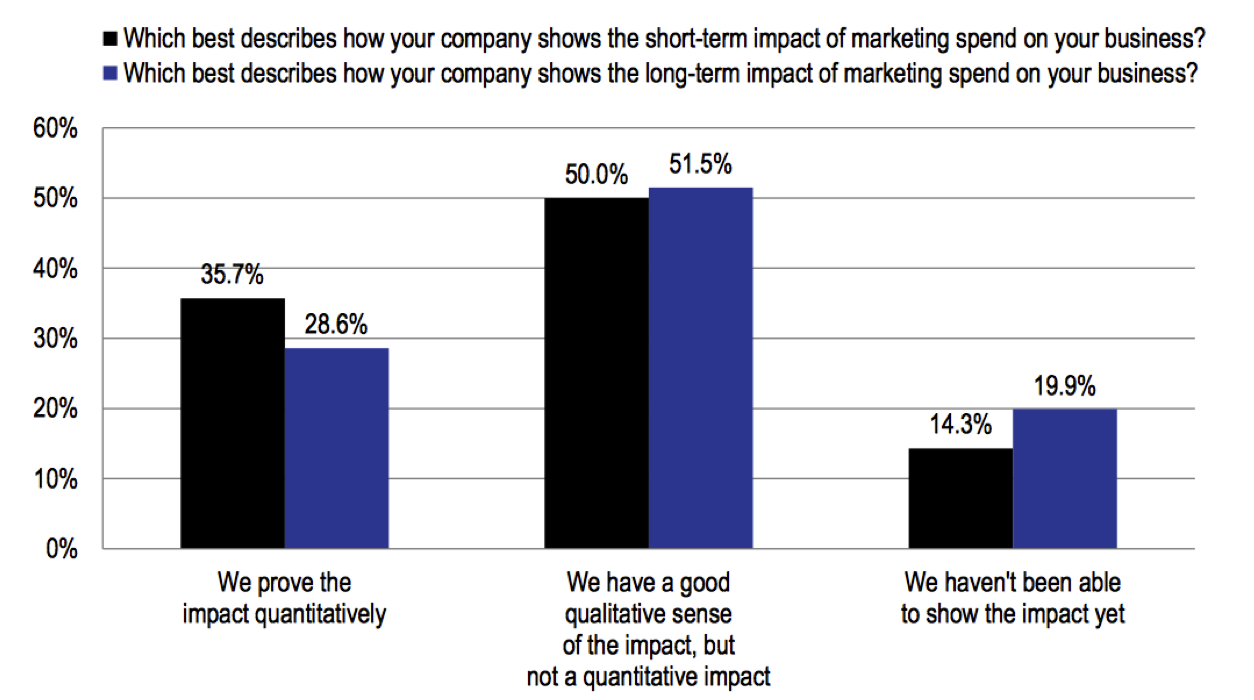
In the age of marketing accountability, one expects more CMOs to have quantitative and nuanced perspectives on what works, when, for which market segments, how, and why?   But the reality, as evidenced in a CMO survey, highlights a paradox and the opportunity for those who get the marketing effectiveness question right.  Only 1 in 3 marketers have a quantitative understanding of the impact of marketing spend, i.e., sales response function.

MarketingEffectiveness


Source: CMO Survey February 2014.

The Paradox:   When the same marketers are posed a question on Marketing ROI and how it has changed, CMOs appear confident in responding with a quantitative metric.    If you don’t have a sales response function, how can you venture an ROI?

***********************

Herein, lies the big opportunity for a select group of CMOs to stand out of the crowd, and befriend the CFO (one who obsesses with the real numbers that matter to any business), CTO (one who helps with ensuring that the technology platform and data exist), and CAO (one who can help make sense of the data in the business context and provide visibility into the future, even if it is blurry).

Rep. Cantor’s Primary Loss: Takeaways for Marketers and Business Leaders

Let us look at some of the stark statistics of the primary challenge.   Rep. Cantor had a campaign fund of more than $5 million while his challenger Dave Brat raised just $300,000.

  1. Customers vote with their wallets:   The key takeaway is from Dave Brat, who said, “The reason we won this campaign, there is just one reason, and that’s because dollars do not vote — you do.”  The product or service you are offering matters much more than the communication about the product or service.
  2. Message relevance:   With a differentiated message relevant to the audience, you don’t need a lot of investment to amplify the message.
  3. Unwavering core principles:  Cantor constantly changed his positions on immigration, bailouts, etc.   Brands to be relevant over long periods need to morph the message as consumers interests and priorities change.   But the core essence of a brand should be non-negotiable.
  4. Don’t go head to head when you are ahead:  Cantor’s aggressive ad spending boosted Brat’s name identification at a time when he didn’t have the wherewithal.
  5. Never underestimate your competition:  Brat’s campaign was run by a relatively inexperienced 23-year old campaign manager armed with a Walmart flip-phone.
  6. Consumer sentiments can change quickly:  As per a poll in late May, Cantor was leading 62%-28%.  Two weeks hence, and Cantor loses by a margin of 10%.
  7. Perils of leadership:  As an executive you may be few layers away from the customer, and consequently, out-of-touch with reality.   Cantor was busy setting the Republican agenda in the Congress, while Brat was working closely with the locals and listening to the likely voters.

Marketing Effectiveness: Long-term versus short-term effect

In recent years, there has been a growing sentiment (supported by anecdotal evidence) that the long-term effects of advertising is diminishing.    Hypothesized causes include:

  1. Growing impact of digital and information availability in consumer shopping and search processes.
  2. Decreasing (product) brand loyalty.
  3. Consumer culture of “here and now” and fleeting consumer interests across product and shopping categories.
  4. Growing plethora of consumer choices in almost any product category.

A recent study conducted by Nielsen Catalina, Kellogg, and CBS concludes that the long-term effect – defined as total sales lift – range from 1.8 to 4.5 times the short-term sales lift.  Such estimates of long-term effects are even higher than similar assessments almost three decades back, further questioning anecdotal evidence.   The wide variation in long-term effects across brands and categories, further highlights the importance of precisely estimating and incorporating the effects in marketing investment optimization.

In order to tease out the long-term effects of advertising investments, we need more granular data on marketing investments within each media and marketing channel, and sales.

  1. Higher temporal resolution:  Hourly and daily marketing stimuli and investment data instead of typical weekly and monthly data.
  2. Improved spatial resolution:   Investments tracked across markets  – DMAs, states, etc.
  3. More precise targeting resolution:  Who is exposed to the advertising? visitors versus prospects versus customers?
  4. Disaggregate customer and sales data:  Sales from existing customers versus new customers? Conversions rates – prospect to new customer to repeat customer? Frequency of purchases by customer type?  Order value by customer type? Customer-level sales data?
  5. Test and control:   Often,  there is the need to design and execute structured experiments to generate the granular data for estimating long-term effects.
  6. Go beyond sales and profit:  To evaluate lasting effects of advertising, we need to marry brand tracking data with marketing effectiveness analysis.

Collating data spanning the upper and lower paths of the customer decision journey and statistically analyzing the interrelationships provides a stronger foundation for marketing investment decisions.


Buying Digital Ads Programmatically: Buyers Beware

Marketers need to be wary of ad tech peddlers claiming to buy ads one impression at a time through a real-time auction.    An interesting quote from Bill Lederer, CEO of MediaCrossing, a programmatic trader, highlights the state of programmatic buying.

“Some of this inventory being showcased as programmatic is being bought with a whole lot of phone calls and emails,” he said. “There’s a certain amount of phoniness in the discussion.”

*******************

Both direct and brand marketers will and must move dollars to programmatic ad buys for many reasons within digital media, and in the future as programmatic buying opens up for “traditional media” such as TV, but weigh the pros and cons carefully.  Reality is lagging well behind the hype.

White-box or Black-box Marketing Analytics?

Many professional services firms claim to have proprietary (or black-box) frameworks and approaches to develop and execute business strategies.    Ability to anticipate the future, creativity, focus, discipline, and analytical horsepower are necessary conditions for business success.  A missing ingredient, for converting business strategies into executable plans and actions, requires organizations to be transparent, encourage healthy debates and challenge assumptions and internal biases, with a clear understanding of data-driven insights and associated limitations.

We are proponents of white-box analytics for the following reasons:

  1. Stories are more compelling than data:  To design new products and services, transform organizations, and build innovative business models, insights from data need to be synthesized into bite (or byte)-sized portions and woven into compelling stories to induce organizational and operational DNA mutations.
  2. Capability development for repeatable and reliable analytics:  The scientific principles underlying a white-box approach, permit internal teams to evaluate the analytical techniques in new contexts and with new data. This ensures development of repeatable systems and decision processes.  Even if you outsource select analytics initiatives, you have to develop internal capability to make core analytics a competitive differentiator and engine of continuous business success.
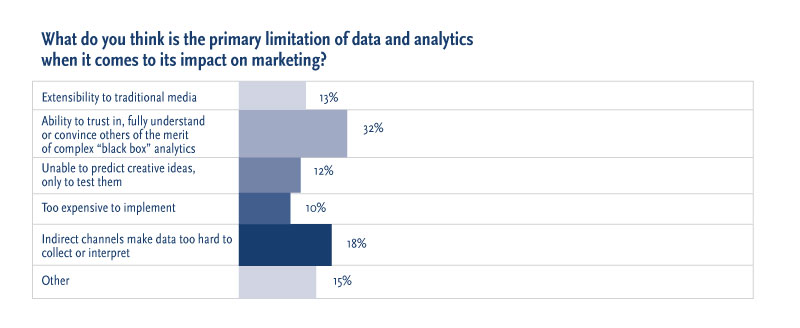
  3. Credibility and trustworthiness of data and approach:  Many CMOs don’t trust big data, analytics, and tools (see below).  Consequently, new ways of doing things are rarely internalized.  Enterprises must internalize and trust the data, analytics, and the underlying assumptions and context in which the insights are generated.  A white-box approach increases the odds of engendering trust, and insights and findings to permeate the organization – teams spread a key insight only if it is trustworthy.
  4. Continuous refinements to analytical techniques:  Often analytical approaches need to evolve as available data, types of data, consumer behaviors, and markets change.   Since these refinements need to be executed within the client’s organization, white-box approaches permit easier refinements – you can’t refine what you don’t understand.
  5. Better creative solutions:  White-box approaches typically favor a deeper understanding of “causes and effects” (“why” questions are more important than the “what” questions for strategic decisions) leading to more creative solutions to marketing strategy development and execution.

Source:  Big Data and the CMO: What’s Changing for Marketing Leadership? CMO Summit Survey Results, Spencer Stuart, April 2013.


From worst to best: What can businesses learn from the Boston Red Sox?

There are often lessons for business from popular culture, arts, and sports.  Here are some lessons from the 2013 Boston Red Sox World Series win.

  1. From tragedy to triumph:  On April 15, 2013, bombings near the finish line of the Boston Marathon killed three people and injured at least 250.  As Rahm Emanuel, Chicago Mayor and ex-White House Chief of Staff said: “You never let a serious crisis go to waste.”   Use your crises as learning moments and catalysts for change.  Also, pay careful attention post-crisis, since crises often lead to poor decisions under business stress.
  2. New leaders challenge the status quo:  With almost similar talent, a new leader, such as a calm, composed, and cerebral manager John Farrell, can make a huge difference.
  3. Visible symbols matter:  Almost all Boston Red Sox players sported ugly, scraggly, preposterous, and sometimes well-groomed beards.  But the beards unified the team in more ways than one.  Also note that the unifying beards didn’t happen at the start of the season.  Rather, they became more prominent midseason as more team members aligned on a shared purpose.
  4. Opportunity to rebuild your team:  Red Sox GM Ben Cherington signed the right players last offseason.  He didn’t have to bring aboard the biggest stars, but got his picks to contribute to winning.  A deftly crafted team with a diversity of skills, experiences, and perspectives will fight hard to succeed.
  5. Culture can change faster than you think:  Often organizational and operational DNA is a key driver of business success.  But there is the myth that cultural change is evolutionary and not revolutionary.  Select changes in a team – such as removal of bad apples swiftly – and bringing in fresh thinking can change the company’s culture faster than most expect, especially after going through a health crisis.
  6. Purpose beats singular focus on business:  It is not just about winning – after all who wants to lose.  But having a higher purpose – to help heal a city – mobilizes all your talent and resources to work together.  In a similar vein, businesses should give priority to a shared purpose – even ahead of business performance metrics such as revenues and margins.  Then, winning is just a by-product.
  7. Reallocate resources for transformational change:  It is easier to reallocate and optimize resources when you are at the bottom than when you are at the top.  Hitherto hard decisions become easy ones as there is less opposition to change and a new sense of urgency drives transformational change in organizations.

Big Data Quote of the Day: 11/01/2013

Quotes in Big Data’ Is Bunk, Obama Campaign’s Tech Guru Tells University Leaders:

“The ‘big’ there is purely marketing,” Mr. Reed said. “This is all fear … This is about you buying big expensive servers and whatnot.”

“The exciting thing is you can get a lot of this stuff done just in Excel,” he said. “You don’t need these big platforms. You don’t need all this big fancy stuff. If anyone says ‘big’ in front of it, you should look at them very skeptically … You can tell charlatans when they say ‘big’ in front of everything.”

**************

Yes, it is true that some data analysis can be done in Excel – for Small Data.   But you may need to process Big Data and synthesize , i.e., make it Small Data, before you can work with Excel.    The value arises from the art and science of data synthesis.

It doesn’t matter what tool you use to process the data.  The most important driver of business performance is whether you have an evidence-based or data-driven decision-making culture in your organization and operations.  If you haven’t used Small Data (survey data, transactional data, etc,.) for developing and executing strategies, and improving business performance in the past, you will be wasting money with your Big Data initiatives.

Business Value of Big Data Analytics

A recent Bain study suggests that  that early adopters of Big Data analytics have gained a significant lead over their competitors.  Bain studied 400+ large companies and found that those with most advanced analytics capabilities are outperforming competitors in more ways then one:  improved financial performance, faster decision-making, more effective execution, and adaptive  decisioning.

          *****************

It is often difficult to disentangle cause and effects –  companies achieved top performance in part due to advanced analytics or top performers are more likely to have an evidence-based organizational and operational DNA and leveraging analytics is just a manifestation of the underlying DNA.   But the positive correlations highlight the significant value potential of Big Data analytics stemming from improved speed and quality of decisions, and continuous refinements during execution.

Big Data Quote of the Day: 10/29/2013

An incredible and amusing quote from Sacramento Kings owner Vivek Ranadive on the Fox Business News today:

“Basketball is just a big data problem”

**************

What is next?  Is creating art just a Big Data problem?  Is becoming the fastest human just a Big Data problem?   Is the Grand Canyon tightrope crossing just a Big Data problem?  Is swimming from Cuba to Florida just a Big Data problem?